Hexacorallia |
Actiniaria |
Actiniidae
Entorno: milieu / zona climática / rango de profundidad / gama de distribución
Ecología
Sessile; rango de profundidad ? - 15 m (Referencia 125532). Tropical
Northwest Pacific, Western Central Pacific.
Longitud en la primera madurez / Tamaño / Peso / Edad
Madurez: Lm ? range ? - ? cm
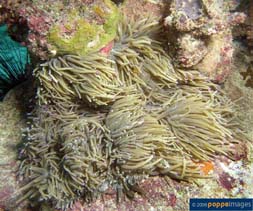
Oral disc is usually around 20 to 30 cm in diameter and can grow up to 50 cm in larger individuals. Tentacles are slender, and may appear tightly coiled or curled near the tips. These tentacles are closely arranged at the circumference of the oral disc, gradually becoming sparse or absent towards the mouth. Oral disc and tentacles vary in color from brown, green, to purplish-gray. The striated pattern is due to white stripes radiating from the mouth, which may extend onto the tentacles. Distinctive white spots are present on the body column.
In shallow waters, to depths of around 15 meters. Has a symbiotic zooxanthellae, which produces food through photosynthesis. Serves a shelter for several anemone shrimps and fishes (Ref. 125532).
Ciclo vital y comportamiento de apareamiento
Madurez | Reproducción | Puesta | Huevos | Fecundidad | Larva
Members of the class Anthozoa are either gonochoric or hermaphroditic. Mature gametes are shed into the coelenteron and spawned through the mouth. Life cycle: The zygote develops into a planktonic planula larva. Metamorphosis begins with early morphogenesis of tentacles, septa and pharynx before larval settlement on the aboral end.
Bisby, F.A., M.A. Ruggiero, K.L. Wilson, M. Cachuela-Palacio, S.W. Kimani, Y.R. Roskov, A. Soulier-Perkins and J. van Hertum 2005 Species 2000 & ITIS Catalogue of Life: 2005 Annual Checklist. CD-ROM; Species 2000: Reading, U.K. (Referencia 19)
Situación en la Lista Roja de la UICN
(Referencia 130435: Version 2025-2 (Global))
Estatus CITES (Referencia 108899)
Not Evaluated
CMS (Referencia 116361)
Not Evaluated
Amenaza para el ser humano
Usos humanos
FAO - Publication: search | FishSource |
Herramientas
Más información
Ecología TróficaAlimentos (presas)
Composición de la dieta
consumo de alimento
Despredadores
Dinámica de la poblaciónCrecimiento
Edades / tallas máximas
Longitud-peso rel.
Longitud-longitud rel.
Longitud-frecuencias
Conversión de masas
Abundancia
Ciclo de vidaReproducciónMadurezFecundidadPuestaHuevosDesarrollo de los huevosLarva FisiologíaConsumo del oxígeno
Relacionados con el ser humanoSellos, monedas, varios
Fuentes de Internet
Estimaciones basadas en modelos
Vulnerabilidad pesquera
(Referencia 71543) |
(0 of 100). |
Categoría de precios
(Referencia 80766): |
Unknown. |