Hexacorallia |
Actiniaria |
Actiniidae
Meio ambiente: milieu / Zona climática / intervalo de profundidade / faixa de distribuição
Ecologia
Sessile; intervalo de profundidade 1 - 10 m (Ref. 364). Subtropical
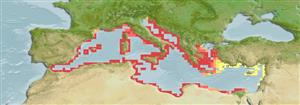
Endemic to the Mediterranean.
Comprimento de primeira maturação / Tamanho / Peso / Idade
Maturidade: Lm ? range ? - ? cm Max length : 12.0 cm WD macho/indeterminado; (Ref. 358)
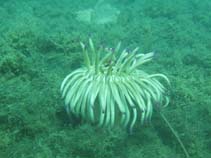
Diameter of the pedal disc: 7 cm; diameter of the oral disc, without the tentacles: 12 cm maximum; 30 cm with its tentacles 96; laid out in 5 crowns around the oral siphon; and measuring approximately 8 cm; thick, they are completed in a round point. Oral disc comprising of the reasons for varied color: gray with nuances white; yellow; green or brown; also gray tentacles with nuances of white; yellow or brown; and with point violet; one the lower third of the foot; as for him, is red orange and counts 12 longitudinal bands of a tinted dirty white of yellow; partially discontinuous (Ref. 358).
Always inserted in the sandy or gravelly funds; the free foot in its substrate and the oral disc as well as the tentacles flat on the surface. Common of the small funds (Ref. 358). Sandy Funds from 1 to 10 m (Ref. 364). Known from infralittoral zones (Ref. 85338). Solitary (Ref. 2377).
Ciclo de vida ou comportamento de acasalamento
Maturidade | Reprodução | Desova | Ovos | Fecundidade | Larvas
Members of the class Anthozoa are either gonochoric or hermaphroditic. Mature gametes are shed into the coelenteron and spawned through the mouth. Life cycle: The zygote develops into a planktonic planula larva. Metamorphosis begins with early morphogenesis of tentacles, septa and pharynx before larval settlement on the aboral end.
Göthel, H. 1992 Guide de la faune sous-marine: La Méditerranée. Invertébrés marins et poissons. Eygen Ulmer GmbH & Co. 318 p. (Ref. 358)
Status na Lista Vermelha da UICN
(Ref. 130435: Version 2025-2 (Global))
Status no CITES (Ref. 108899)
Not Evaluated
Not Evaluated
Ameaça para os humanos
Uso pelos humanos
FAO - Publication: search | FishSource |
Ferramentas
Mais informação
Ecologia TróficaItens alimentares (presas)
Composição da dieta
Consumo alimentar
Predadores
Dinâmica populacionalCrescimento
Idade máxima / tamanhos
Relação comprimento-peso.
Relação comprimento-comprimento.
Frequências de comprimento
Conversão de massa
Abundância
Ciclo de vidaReproduçãoMaturidadeFecundidadeDesovaOvosDesenvolvimento dos ovosLarvas FisiologiaConsumo de oxigênio
Relacionado a humanosSelos, moedas, diversos.
Fontes da internet
Estimativas baseadas em modelos
Vulnerabilidade da pesca
(Ref. 71543) |
Low vulnerability (10 of 100). |
Categoria de preço
(Ref. 80766): |
Unknown. |