Gastropoda |
Littorinimorpha |
Aporrhaidae
Miljö: miljö / Klimatzon / djupintervall / distributionsområde
Ekologi
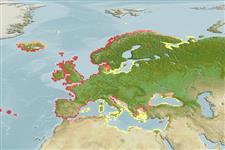
Benthic; djupintervall 6 - 8 m (Ref. 118694). Temperate; 76°N - 25°N, 31°W - 61°E
Northeast Atlantic, Arctic and the Mediterranean: North and Celtic seas. Temperate to polar.
Längd vid första mognad / Storlek / Vikt / Ålder
Könsmognad: Lm ? range ? - ? cmCommon length : 5.1 cm SHL hane/ej könsbestämd; (Ref. 360)
Shell: quite high conical spire, with an outer lip characteristically broadened and fingered, looking like a bird's foot; whorls are angular with a nodular median keel (two in the body whorl); the suture is hardly incised; outer lip of the aperture is thickened, and the inner lip produces a marked columellar callus; development of the external fingers marks the attainment of maturity; sculpture consists of the nodular keel and thin spiral grooves that extend over the whole surface; coloration is variable, white, beige, darkish chestnut, reddish brown or patched, axially flamed with draker shades than the base color; operculum is horny, ellipsoidal and with a terminal nucleus. Body: pink or reddish with whitish spots, foot is very long and narrow; eyes sessile, set at the bases of the long tentacles; mantle cavity has one gill, the osphradium/penis; radula is taenioglossan.
This is a carnivorous species (Ref. 96498).
Livscykel och parningsbeteende
Könsmognad | Reproduktion | Lek | Ägg | Fekunditet | Larver
Members of the order Neotaenioglossa are mostly gonochoric and broadcast spawners. Life cycle: Embryos develop into planktonic trocophore larvae and later into juvenile veligers before becoming fully grown adults.
Sabelli, B. and H.S. Feinberg (eds.) 1879 Simon and Schuster's Guide to Shells. Simon and Schuster's Inc. New York. 512 pp. (Ref. 360)
Status på IUCN:s rödlista
(Ref. 130435: Version 2025-2 (Global))
CITES-status (Ref. 108899)
Not Evaluated
Not Evaluated
Hot mot människor
Mänskliga användningsområden
FAO - Publication: search | FishSource |
Verktyg
Ytterligare information
Trofisk ekologiLivsmedelsartiklar (preys)
Födosammansättning
Födointag
Predatorer
LivscykelReproduktionKönsmognadFekunditetLekÄggUtveckling av äggLarver MänniskorelateradFrimärken, mynt, diverse.
Internet-källor
Uppskattningar baserade på modeller
Sårbarhet i fisket
(Ref. 71543) |
(0 of 100). |
Priskategori
(Ref. 80766): |
Unknown. |