Gastropoda |
Not assigned |
Architectonicidae
Environnement : milieu / zone climatique / profondeur / gamme de distribution
Écologie
Benthic; profondeur 10 - 120 m (Réf. 349), usually 10 - 65 m (Réf. 349). Tropical
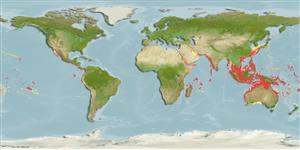
Indo-Pacific: from East Africa, including Madagascar, the Red Sea and the Persian Gulf, to eastern Polynesia; north to Japan and Hawaii, and south to eastern South Australia.
Longueur à la première maturité / Taille / Poids / Âge
Maturité: Lm ? range ? - ? cm Max length : 7.0 cm SHL mâle / non sexé; (Réf. 721); common length : 5.0 cm SHL mâle / non sexé; (Réf. 349)
Description synthétique
Morphologie
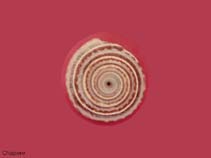
Shell: thin and strong, low spire, breadth more than double the height, whorls are only slightly convex, almost flat, sutures deeply incised; flat base has a fairly wide and deep umbilicus surrounded by a nodular swelling; thin aperture lip is nearly square in shape; sculpture of the body whorl consists of a broad and slightly raised band running below the suture and two narrower and more raised bands at the periphery, with another three on the basal side; all bands are granular as they intersect with the growth lines, which are fairly incised; coloration is light brown on either side of white stripes, following the bands of the sculpture; operculum is horny, dark brown, slightly spiral, roughly central nucleus and with a tubercle on the inner surface. Body: radula is ptenoglossan, without a rachidial tooth and with fourteen pairs of lateral teeth.
Occasional bycatch by shrimp trawlers (Ref. 349). Found on sandy, weedy bottoms (Ref. 799) and muddy bottoms, in sublittoral areas (Ref. 128042). In general, members of the family Architectonicidae are carnivores (Ref. 67623).
Cycle de vie et comportement reproducteur
Maturité | Reproduction | Frai | Œufs | Fécondité | Larves
Members of the order Heterostropha are mostly simultaneous hermaphrodites.
Springsteen, F.J. and F.M. Leobrera 1986 Shells of the Philippines. Carfel Seashell Museum. Metro Manila, Philippines. 377 p. (Réf. 821)
Statut dans la liste rouge de l'IUCN
(Réf. 130435: Version 2025-2 (Global))
statut CITES (Réf. 108899)
Not Evaluated
Not Evaluated
Menace pour l'homme
Utilisations par l'homme
Pêcheries: commercial
FAO - Publication: search | FishSource |
Outils
Plus d'informations
Écologie trophiqueAliments (proies)
Composition du régime alimentaire
Consommation alimentaire
Prédateurs
Dynamique des populations PhysiologieConsommation d'oxygène
Liées à l'hommeTimbres, pièces de monnaie, divers
Sources Internet
Estimations basées sur des modèles
Vulnérabilité de la pêche
(Réf. 71543) |
Low vulnerability (10 of 100). |
Catégorie de prix
(Réf. 80766): |
Unknown. |