Malacostraca |
Stomatopoda |
Odontodactylidae
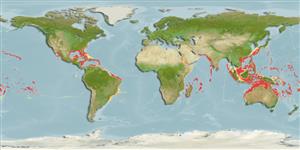
Umwelt: Milieu / Klimazone / Tiefenbereich / Verbreitungsgebiet
Ökologie
Benthic; tiefenbereich 0 - 424 m (Ref. 80410), usually 15 - 40 m (Ref. 93242). Tropical
Western Atlantic and Indo-Pacific.
Länge bei der ersten Reifung / Größe / Gewicht / Alter
Geschlechtsreife: Lm ? range ? - ? cm
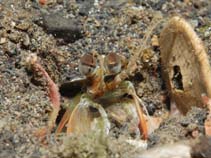
Minimum depth from Ref. 96667. Occurs on mud to fine to coarse sand (Ref. 80410) and stones (Ref. 3121). Usually found in less than 100 m depths, but occurs generally in 40 to 424 m depths. Juveniles can also be found on surface (Ref. 3121).
Lebenszyklus und Paarungsverhalten
Geschlechtsreife | Fortpflanzung | Ablaichen | Eier | Fruchtbarkeit | Larven
Some members of the order Stomatopoda pair for life and some come together only to mate. Males produce sperm ducts rather than spermatophores; females can brood a maximum of 50,000 eggs. Life cycle: Eggs hatch to a planktonic zoea which lasts for 3 months.
Ahyong, S.T. 2002 Stomatopoda (Crustacea) from the Marquesas Islands: results of MUSORSTOM 9. Zoosystema 24(2):347-372. (Ref. 3509)
IUCN Rote Liste Status
(Ref. 130435: Version 2025-2 (Global))
CITES Status (Ref. 108899)
Not Evaluated
Not Evaluated
Bedrohung für Menschen
Nutzung durch Menschen
FAO - Publication: search | FishSource |
Tools
Mehr Information
Trophische ÖkologieLebensmittel (Beutetiere)
Nahrungszusammensetzung
Nahrungsaufnahme
Räuber
PopulationsdynamikWachstum
Max. Alter/Größen
Länge-Gewicht-Rel.
Länge-Länge-Verhältnis.
Längenhäufigkeiten
Massenkonvertierung
Dichte
LebenszyklusFortpflanzungGeschlechtsreifeFruchtbarkeitAblaichenEierEientwicklungLarven PhysiologieSauerstoffverbrauch
MenschenbezogenBriefmarken, Münzen, Verschiedenes.
Internet Quellen
Schätzungen auf der Grundlage von Modellen
Anfälligkeit der Fischerei
(Ref. 71543) |
(0 of 100). |
Preiskategorie
(Ref. 80766): |
Unknown. |