Malacostraca |
Decapoda |
Ocypodidae
Environnement : milieu / zone climatique / profondeur / gamme de distribution
Écologie
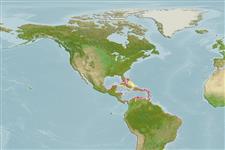
Benthic; saumâtre; profondeur 0 - 1 m (Réf. 114664). Tropical; 31°N - 30°S, 98°W - 34°W
Western Atlantic: from Florida, USA throughout the Antilles to Santa Catarina, Brazil.
Longueur à la première maturité / Taille / Poids / Âge
Maturité: Lm ? range ? - ? cm Max length : 10.0 cm CW mâle / non sexé; (Réf. 367); âge max. reporté: 10 années (Réf. 101693)
Description synthétique
Morphologie
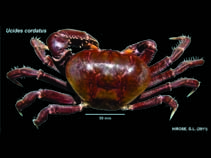
Carapace broadly egg-shaped, narrow posteriorly, its length slightly less than 4/5 of width, strongly convex longitudinally, nearly subcylindrical in midline, and smooth but with regions well outlined; lateral marginal ridges regularly curved, not divided into lobes, converging posteriorly; fronto-orbital distance (space between outer orbital angles) not more than 2/3 of maximum carapace width in adult males. Pincers elongate, usually somewhat dissimilar and unequal in both sexes, armed with sometimes strong spines or sharp tubercles on inner margins; fingers of major hand slightly longer than palm; dactyls of walking legs ridged but not spiny, legs of males bearing very low silky hairs. Color: carapace usually bluish with some yellowish areas, legs pinkish; hairs on legs grey to almost black, lateral margins of carapace dark in adults.
Found in estuaries (Ref. 104235). Supratidal to intertidal (Ref. 97531). Commonly associated with mangroves. Lives in burrows as deep as 70 cm, always reaching to the water table, either in open ground or under vegetation; often occurring among burrows of other crabs (Cardisoma, Uca, and Goniopsis spp. The most sluggish of the land crabs (Ref. 367). Herbivorous and detritivorous (Ref. 86356), feeding mainly on mangrove leaves along with other plant material, detritus, sediment and animal material (Ref. 104111). Either directly consumes mangrove leaf litter or stores it in the burrows (Ref. 104235).
Cycle de vie et comportement reproducteur
Maturité | Reproduction | Frai | Œufs | Fécondité | Larves
Tavares, M. 2003 True Crabs. pp. 327-352. In Carpenter, K.E. (ed.) The living marine resources of the Western Central Atlantic. Volume1: introdution, molluscs, crustaceans, hagfishes, sharks, batoid fishes, and chimaeras. FAO Species Identification Guide for Fishery Purposes and American Society of Ichthyologists and Herpetologists Special PublicationNo. 5. Rome, FAO. pp. 1-600. (Réf. 367)
Statut dans la liste rouge de l'IUCN
(Réf. 130435: Version 2025-2 (Global))
statut CITES (Réf. 108899)
Not Evaluated
Not Evaluated
Menace pour l'homme
Utilisations par l'homme
Pêcheries: commercial
FAO - Publication: search | FishSource |
Outils
Plus d'informations
Dynamique des populations PhysiologieConsommation d'oxygène
Liées à l'hommeTimbres, pièces de monnaie, divers
Sources Internet
Estimations basées sur des modèles
Résilience
(Ref. 69278): |
Haut, temps minimum de doublement de population inférieur à 15 mois (K=0.15-1.22; tm=2.9; tmax=10) |
Vulnérabilité de la pêche
(Réf. 71543) |
Low to moderate vulnerability (30 of 100). |
Catégorie de prix
(Réf. 80766): |
Unknown. |