Malacostraca |
Decapoda |
Portunidae
Miljö: miljö / Klimatzon / djupintervall / distributionsområde
Ekologi
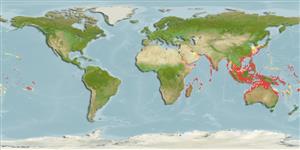
Benthic; brackvatten; djupintervall 0 - 80 m (Ref. 125642). Tropical; 36°N - 31°S, 30°E - 135°W
Indo-Pacific. From East Africa to French Polynesia, north to Japan and south to Australia. Tropical to temperate.
Längd vid första mognad / Storlek / Vikt / Ålder
Könsmognad: Lm 8.3, range 8 - ? cm Max length : 20.0 cm CW hane/ej könsbestämd; (Ref. 343); 21.5 cm CW (female); rapporterad maxålder: 3.00 år (Ref. 128174)
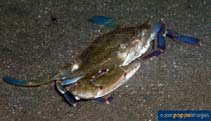
Carapace finely granulose, regions just discernible; 9 teeth on each anterolateral margin, the last tooth 2 to 3 times larger than preceding teeth. Chelae elongated in males; larger chela with conical tooth at base of fingers; pollex ridged. Color: olive to dark green, with 3 prominent maroon to red spots on posterior 1/3 of carapace. Easily distinguished from other species by its very distinct color markings.
Maximum length (female) from Ref. 119750. Occurs from the intertidal zone (especially juveniles) to depths of 30 m (Ref. 343). Subtidal (Ref. 106854). Inhabits sandy to sandy-muddy substrates (Refs. 343, 106287, 125338), in bays and estuaries (Ref. 106287). Also in brackish water (Ref. 801). Subtropical and tropical climates (Ref. 343). Mainly a predator of sessile and slow-moving benthic macroinvertebrates (Ref. 102720); may be a scavenger (Ref. 100855). Omnivore (Ref. 116259).
Members of the order Decapoda are mostly gonochoric. Mating behavior: Precopulatory courtship ritual is common (through olfactory and tactile cues); usually indirect sperm transfer.
Ng, P.K.L. 1998 Crabs. p. 1045-1155. In K.E. Carpenter and V.H. Niem (eds) FAO species identification guide for fishery purposes. The living marine resources of the Western Central Pacific. Volume 2. Cephalopods, crustaceans, holothurians and sharks. Rome, FAO. 1998. pp. 687-1396. (Ref. 343)
Status på IUCN:s rödlista
(Ref. 130435: Version 2025-2 (Global))
CITES-status (Ref. 108899)
Not Evaluated
Not Evaluated
Hot mot människor
Mänskliga användningsområden
Fiskeri: kommersiell
FAO - Publication: search | FishSource | Havet omkring oss
Verktyg
Ytterligare information
MänniskorelateradFrimärken, mynt, diverse.
Internet-källor
Uppskattningar baserade på modeller
Resiliens
(Ref. 69278): |
Hög, lägsta populationsfördubblingstid mindre än 15 månader (K=0.82-1.9; tm=0.65; tmax=3) |
Sårbarhet i fisket
(Ref. 71543) |
Low vulnerability (15 of 100). |
Priskategori
(Ref. 80766): |
High. |
Nutrients
|
Calcium = 109 [35, 184] mg/100g; Iron = 1.59 [1.21, 1.97] mg/100g; Protein = 20.2 [19.2, 21.3] %; Omega3 = 0.285 [0.185, 0.386] g/100g; Selenium = 48.3 [-31.7, 128.3] μg/100g; VitaminA = 0 μg/100g; Zinc = 1.79 [1.17, 2.40] mg/100g (wet weight); based on nutrient studies. |