Malacostraca |
Decapoda |
Homolidae
Environnement : milieu / zone climatique / profondeur / gamme de distribution
Écologie
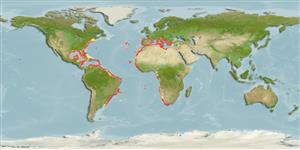
Benthic; profondeur 10 - 682 m (Réf. 62709). Tropical; 46°N - 38°S, 98°W - 37°E
Atlantic Ocean and the Mediterranean: from USA (Massachusetts, and Virginia to south Florida), West Indies, Central America and Brazil (Rio de Janeiro to Rio Grande do Sul) to Western Africa, including Canary and Madeira Islands, to Mediterranean Sea, and northeastern Atlantic from Spain to Portugal. Temperate to tropical.
Longueur à la première maturité / Taille / Poids / Âge
Maturité: Lm ? range ? - ? cm Max length : 1.5 cm CW mâle / non sexé; (Réf. 93549)
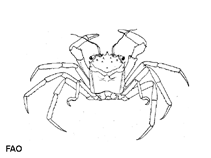
Carapace width range: 1.22 to 1.47 cm (Ref. 93549). Maximum depth from 95880. Found on moderate depths from 10 to 679 m on mud, muddy sand, sandy and muddy detritus, coralline algae, calcareous algae, slightly sandy mud with funiculines, alcyonarians in mud, and reddish gravel with shell debris (Ref. 62709). In general, members of the family Homolidae are carnivorous (Ref. 107107).
Cycle de vie et comportement reproducteur
Maturité | Reproduction | Frai | Œufs | Fécondité | Larves
Members of the order Decapoda are mostly gonochoric. Mating behavior: Precopulatory courtship ritual is common (through olfactory and tactile cues); usually indirect sperm transfer.
Coelho Filho, P.A. 2004 Análise do macrobentos na plataforma continental externa e bancos oceânicos do nordeste do Brasil no âmbito do programa REVIZEE. Grupo de estudo do Bentos (Oceanografia Biológica), Programa REVIZEE. 81 p. (Réf. 2364)
Statut dans la liste rouge de l'IUCN
(Réf. 130435: Version 2025-2 (Global))
statut CITES (Réf. 108899)
Not Evaluated
Not Evaluated
Menace pour l'homme
Utilisations par l'homme
FAO - Publication: search | FishSource |
Outils
Plus d'informations
Écologie trophiqueAliments (proies)Composition du régime alimentaireConsommation alimentairePrédateurs Dynamique des populationsCroissanceÂges / tailles maximalesLongueur-poids rel.Rel. longueur-longueur.Fréquences de longueursConversion de masseAbondance Cycle de vieReproductionMaturitéFéconditéFraiŒufsDéveloppement de l'œufLarves PhysiologieConsommation d'oxygène
Liées à l'hommeTimbres, pièces de monnaie, divers
Sources Internet
Estimations basées sur des modèles
Vulnérabilité de la pêche
(Réf. 71543) |
Low vulnerability (10 of 100). |
Catégorie de prix
(Réf. 80766): |
Unknown. |