Merostomata |
Xiphosura |
Limulidae
Environnement : milieu / zone climatique / profondeur / gamme de distribution
Écologie
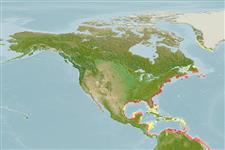
Benthic; profondeur 3 - 290 m (Réf. 137822). Tropical, preferred 24°C (Réf. 107945); 44°N - 18°N, 93°W - 66°W
Western Atlantic: Known from the Gulf of Maine to Florida, USA and along the coast of the Gulf of Mexico from Florida to the Yucatan Peninsula, but absent from the western and southern Gulf of Mexico (from Texas, USA to Tabasco, Mexico). Introduced in Northeast Atlantic.
Longueur à la première maturité / Taille / Poids / Âge
Maturité: Lm ? range ? - ? cm Max length : 60.0 cm TL mâle / non sexé; (Réf. 82); poids max. publié: 1.8 kg (Réf. 82); âge max. reporté: 20 années (Réf. 99652)
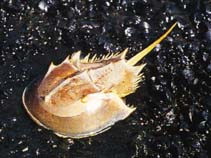
The males are approximately 1/3 the size of the females (sexual dimorphism) (Ref. 83). Minimum depth based from Ref. 76. Lives in shallow waters, with sandy or muddy bottoms (Ref. 76). Found in intertidal and offshore areas (Ref. 1131). The horseshoe crab feeds at night on polychaete worms such as Cerebratulus, Nereis, and Cistenides (Ref. 76, 77), small mollusks, and seaweed (algae) found in the sandy ocean bottom (Ref. 76). Food is picked up by the chelicerae and passed back to the bristle bases, where it is "chewed." The food is then moved forward to the mouth (Ref. 75). It digs its food from sediments, grasping the prey with its legs. The prey is moved to the gnathobases where it is crushed before being pushed forward toward the mouth (Ref. 77). A life span of about 20 to 40 years (Ref. 78). Its predators are loggerhead turtles, pufferfish, leopard sharks and sea gulls (Ref. 82).
Cycle de vie et comportement reproducteur
Maturité | Reproduction | Frai | Œufs | Fécondité | Larves
They reproduce with the use of the first pair of the six, flap-like appendages on the underside of the abdomen acts as a cover for the genital pore. The egg or sperm are released through this pore during spawning (Ref. 75). These eggs are fertilized by sperm released by an attached male and by one or more satellite males that typically congregate around the nesting pair (Ref. 81). While nesting, females bury themselves in the sediment near the water's edge and lay a series of discrete egg clusters, each containing 2,000-20,000 eggs (Ref. 80).
Lee, C.N. and B. Morton 2005 Experimentally derived estimates of growth by juvenile Tachypleus tridentatus and Carcinoscorpius rotundicauda (Xiphosura) from nursery beaches in Hongkong. Journal of Experimental Marine Biology and Ecology 318:39-49. (Réf. 1131)
Statut dans la liste rouge de l'IUCN
(Réf. 130435: Version 2025-2 (Global))
statut CITES (Réf. 108899)
Not Evaluated
Not Evaluated
Menace pour l'homme
Harmless
Utilisations par l'homme
Pêcheries: commercial
FAO - pêcheries: landings search; Publication: search | FIRMS (Stock assessments) | FishSource | Sea Around Us
Outils
Plus d'informations
Dynamique des populations PhysiologieConsommation d'oxygène
Liées à l'hommeTimbres, pièces de monnaie, divers
Sources Internet
Estimations basées sur des modèles
Vulnérabilité de la pêche
(Réf. 71543) |
High to very high vulnerability (66 of 100). |
Vulnérabilité climatique
(Réf. 125649) |
High to very high vulnerability (75 of 100) |
Catégorie de prix
(Réf. 80766): |
Low. |
Nutrients
|
Calcium = 126 [75, 177] mg/100g; Iron = 4.79 [1.67, 7.92] mg/100g; Protein = 16.6 [15.4, 17.8] %; Omega3 = 0.331 [0.263, 0.400] g/100g; Selenium = 57.8 [48.5, 67.2] μg/100g; VitaminA = 0 μg/100g; Zinc = 1.97 [0.92, 3.02] mg/100g (wet weight); based on nutrient studies. |