Gastropoda |
Lepetellida |
Haliotidae
Milieu: milieu / Klimaatzone / Diepte / verspreidingsgebied
Ecologie
Benthic; diepte 0 - 10 m (Ref. 349). Tropical
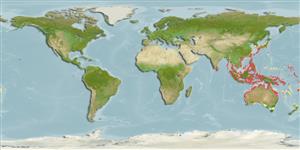
Indo-West Pacific.
Lengte bij maturiteit / Grootte / Gewicht / Leeftijd
Maturiteit: Lm ?, range 4 - ? cm Max length : 12.0 cm ShH mannelijk / geslacht onbekend; (Ref. 349); common length : 9.0 cm SHL mannelijk / geslacht onbekend; (Ref. 349)
The shell is thin, elongate-ovate in outline with slightly protruding spire. Outer lip slightly sinuous in the middle. Outer surface almost smooth. Holes ovate, nearly flush with surafce of shell, the last 5 to 7 holes open. Colouration: Shell shiny, olive green or brown, with several triangular patches of pale green or cream. Inside of shell highly iridescent (Ref. 128042).
Actively collected in the Southeast Asian countries, for its shell and large fleshy animal (Ref. 349). Found in intertidal, on corals (Refs. 75835, 128042). Common, but not aggregating in dense populations. In life, the exceptionally large green mantle almost covers the shell, which is then devoid of encrusting marine growths, unlike those of the other species (Ref. 349). Very active at night (Ref. 799). Feeds on epilithic algae by grazing (Ref. 85382).
Members of the order Patellogastropoda are mostly gonochoric and broadcast spawners. Life cycle: Embryos develop into planktonic trocophore larvae and later into juvenile veligers before becoming fully grown adults.
Poutiers, J.M. 1998 Gastropods. p. 363-648. In Carpenter, K. E. and V. H. Niem. 1998. FAO species identification guide for fishery purposes. The living marine resources of the Western Central Pacific. Volume 1. Seaweeds, corals, bivalves, and gastropods. Rome, FAO. (Ref. 349)
Status op de Rode Lijst van het IUCN
(Ref. 130435: Version 2025-2 (Global))
CITES status (Ref. 108899)
Not Evaluated
Not Evaluated
Gevaar voor de mens
Gebruik door de mens
Visserij: commercieel
FAO - Publication: search | FishSource |
Tools
Meer informatie
FysiologieZuurstofverbruik
Menselijk gerelateerdPostzegels, munten, diversen.
Internetbronnen
Schattingen op basis van modellen
Kwetsbaarheid van de visserij
(Ref. 71543) |
Low vulnerability (10 of 100). |
Prijsklasse
(Ref. 80766): |
Very high. |