Gastropoda |
Lepetellida |
Haliotidae
Environnement : milieu / zone climatique / profondeur / gamme de distribution
Écologie
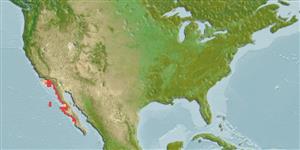
Benthic; profondeur 0 - 18 m (Réf. 865). Subtropical; 34°N - 24°N, 120°W - 111°W
Eastern Pacific: USA to Mexico. Ranges from Point Conception, California (Ref. 865) to Bahia Magdalena, Baja California, Mexico (Ref. 101430). Introduced in China and Israel.
Longueur à la première maturité / Taille / Poids / Âge
Maturité: Lm ?, range 6 - 12.8 cm Max length : 25.0 cm SHL mâle / non sexé; (Réf. 865)
It is found on rock crevices from low intertidal to a depth of 18 meters (Ref. 865). Juveniles occur in crevices and other cryptic sites during daytime; moves out at night to forage and returns to home site at dawn. Adults stay on home sites; forages on drift algae and occasionally on attached algae (Ref. 101619).
Broadcast spawners, breeds year-round. Life cycle: Embryos develop into planktonic trocophore larvae and later into juvenile veligers before becoming fully grown adults (Ref. 833).
Gotshall, D.W. 2005 Guide to marine invertebrates: Alaska to Baja California, 2nd ed. (revised). Sea Challengers. 117 p. (Réf. 865)
Statut dans la liste rouge de l'IUCN
(Réf. 130435: Version 2025-2 (Global))
statut CITES (Réf. 108899)
Not Evaluated
Not Evaluated
Menace pour l'homme
Utilisations par l'homme
Pêcheries: commercial
FAO - Publication: search | FishSource |
Outils
Plus d'informations
Dynamique des populations PhysiologieConsommation d'oxygène
Liées à l'hommeTimbres, pièces de monnaie, divers
Sources Internet
Estimations basées sur des modèles
Résilience
(Ref. 69278): |
Haut, temps minimum de doublement de population inférieur à 15 mois (K=0.38; tm=2.25) |
Vulnérabilité de la pêche
(Réf. 71543) |
Moderate vulnerability (36 of 100). |
Catégorie de prix
(Réf. 80766): |
Very high. |