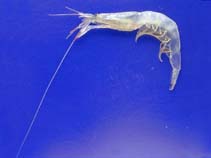
Malacostraca |
Decapoda |
Pasiphaeidae
Umwelt: Milieu / Klimazone / Tiefenbereich / Verbreitungsgebiet
Ökologie
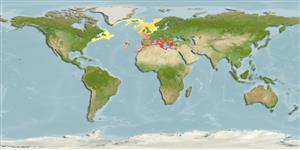
Pelagisch; tiefenbereich 0 - 1022 m (Ref. 122930), usually 100 - 300 m (Ref. 8). Subtropical; 60°N - 27°N, 19°W - 36°E
Eastern Atlantic and the Mediterranean: from Scotland and Norway, south to Canary Islands and east to Turkey, eastern Mediterranean.
Länge bei der ersten Reifung / Größe / Gewicht / Alter
Geschlechtsreife: Lm ?, range 1 - ? cm Max length : 2.2 cm CL Männchen/unbestimmt; (Ref. 8)
Minimum depth from Ref. 8. Benthopelagic (Ref. 105772). Mesopelagic (Ref. 122930). Known from pelagic depths between 100 to 200 m (Ref. 92299). Abundant on the upper slope (Ref. 105772). Associated with the gorgonacean coral Isidella elongata (Ref. 122886). Found on seamounts (Ref. 122931). Carries out diel vertical migrations. Diet is based on pelagic crustaceans like euphausiids and calanoids, and bottom feeding has been reported to be minimal, as is the passive ingestion of forams. However, at night, large specimens feed near the bottom on suprabenthic gammarid amphipods. In general, predatory activity occurs higher in the water column at night (Ref. 105773).
Members of the order Decapoda are mostly gonochoric. Mating behavior: Precopulatory courtship ritual is common (through olfactory and tactile cues); usually indirect sperm transfer.
Williams, A.B., L.G. Abele, D.L. Felder, H.H. Hobbs Jr., R.B. Manning, P.A. McLaughlin and I. Pérez Farfante 1988 Common and scientific names of aquatic invertebrates from the United States and Canada: decapod crustaceans. American Fisheries Society Special Publication 17. 77 pp. + 12 figs. (Ref. 2214)
IUCN Rote Liste Status
(Ref. 130435: Version 2025-2 (Global))
CITES Status (Ref. 108899)
Not Evaluated
Not Evaluated
Bedrohung für Menschen
Nutzung durch Menschen
Fischereien: kommerziell
FAO - Publication: search | FishSource |
Tools
Mehr Information
PhysiologieSauerstoffverbrauch
MenschenbezogenBriefmarken, Münzen, Verschiedenes.
Internet Quellen
Schätzungen auf der Grundlage von Modellen
Widerstandsfähigkeit
(Ref. 69278): |
hoch, Verdopplung der Population dauert weniger als 15 Monate. (K=0.55-0.62) |
Anfälligkeit der Fischerei
(Ref. 71543) |
Low vulnerability (21 of 100). |
Preiskategorie
(Ref. 80766): |
Unknown. |