Malacostraca |
Decapoda |
Pandalidae
Umwelt: Milieu / Klimazone / Tiefenbereich / Verbreitungsgebiet
Ökologie
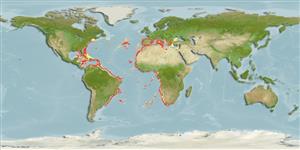
Benthic; tiefenbereich 190 - 1550 m (Ref. 106425), usually 500 - 750 m (Ref. 106425). Subtropical; 45°N - 38°S, 89°W - 34°E
Atlantic Ocean and the Mediterranean: From Portugal to South Africa (West African waters from 16° to 28°S) and Straits of Florida to Turkey.
Länge bei der ersten Reifung / Größe / Gewicht / Alter
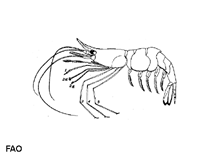
Geschlechtsreife: Lm ? range ? - ? cm Max length : 8.5 cm TL Männchen/unbestimmt; (Ref. 804)
Found on the middle continental slope (Ref. 105377). Non-migrator macrozooplankton feeder (Ref. 52384). Active predator of macroplankton species. Diet is based on smaller prey like siphonophores, hyperiids and euphausiids (Ref. 105341).
Lebenszyklus und Paarungsverhalten
Geschlechtsreife | Fortpflanzung | Ablaichen | Eier | Fruchtbarkeit | Larven
Members of the order Decapoda are mostly gonochoric. Mating behavior: Precopulatory courtship ritual is common (through olfactory and tactile cues); usually indirect sperm transfer.
Bianchi, G., K.E. Carpenter, J.-P. Roux, F.J. Molloy, D. Boyer and H.J. Boyer 1999 FAO species identification guide for fishery purposes. Field guide to the living marine resources of Namibia. Rome, FAO. 265 p., 11 plates. (Ref. 804)
IUCN Rote Liste Status
(Ref. 130435: Version 2025-2 (Global))
CITES Status (Ref. 108899)
Not Evaluated
Not Evaluated
Bedrohung für Menschen
Nutzung durch Menschen
FAO - Publication: search | FishSource |
Tools
Mehr Information
LebenszyklusFortpflanzungGeschlechtsreifeFruchtbarkeitAblaichenEierEientwicklungLarven PhysiologieSauerstoffverbrauch
MenschenbezogenBriefmarken, Münzen, Verschiedenes.
Internet Quellen
Schätzungen auf der Grundlage von Modellen
Widerstandsfähigkeit
(Ref. 69278): |
hoch, Verdopplung der Population dauert weniger als 15 Monate. (K=0.5-0.55) |
Anfälligkeit der Fischerei
(Ref. 71543) |
Low vulnerability (24 of 100). |
Preiskategorie
(Ref. 80766): |
Very high. |