Cephalopoda |
Octopoda |
Octopodidae
Umwelt: Milieu / Klimazone / Tiefenbereich / Verbreitungsgebiet
Ökologie
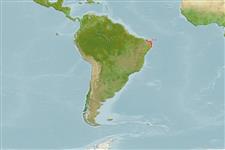
Riff-verbunden; tiefenbereich 0 - 45 m (Ref. 96968). Subtropical; 35°N - 25°S, 98°W - 9°E (Ref. 131170)
Western Atlantic.
Länge bei der ersten Reifung / Größe / Gewicht / Alter
Geschlechtsreife: Lm 6.0 range ? - ? cm Max length : 12.0 cm ML Männchen/unbestimmt; (Ref. 96968); max. veröff. Gewicht: 1.3 kg (Ref. 96968)
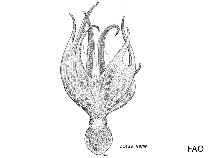
Total length to 53 cm (Ref. 96968). Common in coastal Northeastern Brazil and its oceanic islands (Ref. 104094). Found on bedrock and gravel, regardless of the presence of algae (Ref. 96968). Also occurs on sand beds, rocky bottoms (Ref. 104094) and crevices on hard substrates (Ref. 104098).
Male and female adults usually die shortly after spawning and brooding, respectively. Mating behavior: Males perform various displays to attract potential females for copulation. During copulation, male grasp the female and inserts the hectocotylus into the female's mantle cavity where fertilization usually occurs (Ref. 833). Spawning occurs in deeper waters (Ref. 104886). Life cycle: Embryos hatch into planktonic stage and live for some time before they grow larger and take up a benthic existence as adults (Ref. 833).
Leite, T.S., M. Haimovici, W. Molina and K. Warnke 2008 Morphological and genetic description of Octopus insularis, a new cryptic species in the Octopus vulgaris complex (Cephalopoda: Octopodidae) from the tropical southwestern Atlantic. Journal of Molluscan Studies 74(1):63-74. (Ref. 84317)
IUCN Rote Liste Status
(Ref. 130435: Version 2025-2 (Global))
CITES Status (Ref. 108899)
Not Evaluated
Not Evaluated
Bedrohung für Menschen
Harmless
Nutzung durch Menschen
Fischereien: kommerziell
FAO - Publication: search | FishSource |
Tools
Mehr Information
PopulationsdynamikWachstumMax. Alter/GrößenLänge-Gewicht-Rel.Länge-Länge-Verhältnis.LängenhäufigkeitenMassenkonvertierungDichte PhysiologieSauerstoffverbrauch
MenschenbezogenBriefmarken, Münzen, Verschiedenes.
Internet Quellen
Schätzungen auf der Grundlage von Modellen
Anfälligkeit der Fischerei
(Ref. 71543) |
Low vulnerability (10 of 100). |