Malacostraca |
Decapoda |
Diogenidae
Environnement : milieu / zone climatique / profondeur / gamme de distribution
Écologie
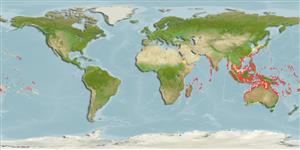
Récifal; profondeur 0 - 50 m (Réf. 96667). Tropical; 38°N - 36°S, 32°E - 134°W
Indo-Pacific: East Africa to Hawaii.
Longueur à la première maturité / Taille / Poids / Âge
Maturité: Lm ? range ? - ? cm Max length : 20.0 cm TL mâle / non sexé; (Réf. 101422); âge max. reporté: 30 années (Réf. 100471)
Description synthétique
Morphologie
Spermatophore has a total length of 0.0016 cm, a stalk that is 0.0090 cm long and 0.0020 cm wide and an ampulla that is 0.0060 cm long and 0.0045 cm wide (Ref. 2889).
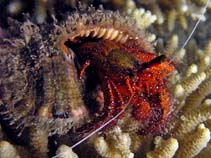
Maximum depth from Ref. 85195. Intertidal to 50 m (Ref. 85195). Also occurs from littoral and subtidal zones (Ref. 2884); associated with coral reef, reef flats, rocky platform, rubble, sand (Ref. 81753), seagrass bed and algal mat (Ref. 106227). On coral heads in lagoons (Ref. 74671). Reported to feed on holothurians (Ref. 106232). Opportunistic omnivore (Ref. 100471).
Cycle de vie et comportement reproducteur
Maturité | Reproduction | Frai | Œufs | Fécondité | Larves
Members of the order Decapoda are mostly gonochoric. Mating behavior: Precopulatory courtship ritual is common (through olfactory and tactile cues); usually indirect sperm transfer.
Barnes, D.K.A. and R.J. Arnold 2001 Ecology of subtropical hermit crabs in S.W. Madagascar: cluster structure and function. Mar. Biol. 139:463-474. (Réf. 2884)
Statut dans la liste rouge de l'IUCN
(Réf. 130435: Version 2025-2 (Global))
statut CITES (Réf. 108899)
Not Evaluated
Not Evaluated
Menace pour l'homme
Utilisations par l'homme
Pêcheries: commercial
FAO - Publication: search | FishSource | Sea Around Us
Outils
Plus d'informations
Dynamique des populationsCroissance
Âges / tailles maximales
Longueur-poids rel.
Rel. longueur-longueur.
Fréquences de longueurs
Conversion de masse
Abondance
Cycle de vieReproductionMaturitéFéconditéFraiŒufsDéveloppement de l'œufLarves PhysiologieConsommation d'oxygène
Liées à l'hommeTimbres, pièces de monnaie, divers
Sources Internet
Estimations basées sur des modèles
Vulnérabilité de la pêche
(Réf. 71543) |
Moderate to high vulnerability (46 of 100). |
Catégorie de prix
(Réf. 80766): |
Unknown. |
Nutrients
|
Calcium = 109 [35, 184] mg/100g; Iron = 1.59 [1.21, 1.97] mg/100g; Protein = 20.2 [19.2, 21.3] %; Omega3 = 0.285 [0.185, 0.386] g/100g; Selenium = 48.3 [-31.7, 128.3] μg/100g; VitaminA = 0 μg/100g; Zinc = 1.79 [1.17, 2.40] mg/100g (wet weight); based on nutrient studies. |