Malacostraca |
Decapoda |
Thalassinidae
Ambiente: milieu / zona climática / intervalo de profundidade / gama de distribuição
Ecologia
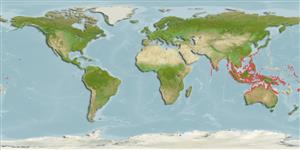
Benthic; estuarina. Tropical; 31°N - 24°S, 73°E - 169°W (Ref. 4)
Indo-Pacific.
Comprimento na primeira maturidade / Tamanho / Peso / Idade
Maturidade: Lm ? range ? - ? cmCommon length : 30.0 cm TL macho/indeterminado; (Ref. 4)
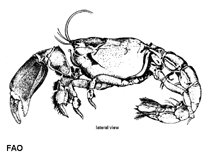
The integument of the body is very firm. The carapace is high; in dorsal view it is elongate oval in outline. In adults the carapace measures less than 1/3 of the total body length. The rostrum is narrowly triangular and short; it is depressed and its lateral margins continue for some distance on the carapace as short divergent ridges. The rostrum has no teeth. The carapace ends posteriorly in a distinct posteriorly directed median tooth that overhang the articulation with the first abdominal somite. The abdomen is long and narrow, more than 5 times as long as wide in the males, about 4 times as long as wide in the females. The somites are of about equal width throughout their length they have a longitudinal carina over the base of the pleura. The telson is about as long as the previous somite, but slightly narrower, the posterior margin is broadly rounded. The uropods are styliform. The eye are small. The first pair of pereiopods is very strong and assymetrical, both chelae and subchelate, the larger less conspicuously so than the smaller. The second legs are smaller, also subchelate; the other legs are simple. Epipods are present on the pereiopods. Colour: the whole body is rather uniformly yellowish or reddish brown (Ref. 4).
It has a total body length of 16 to 30 cm (Ref. 4). It lives in the littoral and supralittoral zones, where it digs its burrows. It is found in mangrove areas and estuaries; the excavated mud forms a kind of chimney or mound over the openings of the burrows, and because of their height form a most conspicuous feature in the landscape. The chimneys can be 75 cm high, but sometimes several chimneys together can form complex hills of mud up to 1.5 m high. The burrows go down vertically or obliquely to the water level after which they make zigzags and side branches; the depths of the burrows has been estimated to be up to 2.5 m. They are rarely seen out of their burrows, not even at night, but it seems that after heavy rainfall they may venture outside. They are sluggish and are definitely mud feeders. Their burrowing activities usually take place at night (Ref. 4).
Ciclo de vida e comportamento de acasalamento
Maturidade | Reprodução | Desova | Ovos | Fecundidade | Larvas
Members of the order Decapoda are mostly gonochoric. Mating behavior: Precopulatory courtship ritual is common (through olfactory and tactile cues); usually indirect sperm transfer.
Holthuis, L.B. 1991 FAO Species Catalogue. Vol. 13. Marine lobsters of the world. An annotated and illustrated catalogue of species of interest to fisheries known to date. FAO Fish. Synop. 125(13):292p. Rome: FAO. (Ref. 4)
Categoria na Lista Vermelha da IUCN
(Ref. 130435: Version 2025-2 (Global))
Categoria CITES (Ref. 108899)
Not Evaluated
Not Evaluated
Ameaça para o homem
Utilização humana
Pescarias: pouco comercial
FAO - Publication: search | FishSource |
Ferramentas
Mais informação
Ecologia TróficaProdutos alimentares (presas)
Composição da dieta
Consumo alimentar
Predadores
Dinâmica das populaçõesCrescimentoIdades / tamanhos máximosComprimento-peso rel.Comprimento-comprimento rel.Frequência de comprimentoConversão de massaAbundância Ciclo de vidaReproduçãoMaturidadeFecundidadeDesovaOvosDesenvolvimento dos ovosLarvas FisiologiaConsumo de oxigénio
Relacionado com o ser humanoSelos, moedas, diversos.
Fontes da internet
Estimativas baseadas em modelos
Vulnerabilidade da pesca
(Ref. 71543) |
(0 of 100). |
Categoria de preço
(Ref. 80766): |
Unknown. |