Malacostraca |
Decapoda |
Scyllaridae
Ambiente: milieu / zona climatica / distribuzione batimetrica / gamma di distribuzione
Ecologia
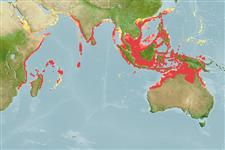
Benthic; distribuzione batimetrica 20 - 200 m (Fonte Biblio. 4), usually 20 - 60 m (Fonte Biblio. 4). Tropical; 28°N - 21°S, 34°E - 148°E (Fonte Biblio. 4)
Indo-West Pacific: from Red Sea, East Africa and Madagascar to Japan, Taiwan, the Philippines, Indonesia and N.E. Australia.
Lunghezza alla prima maturità / Dimensione / Peso / Età
Maturità: Lm ? range ? - ? cm Max length : 2.3 cm CL maschio/sesso non determinato; (Fonte Biblio. 89665); common length : 6.0 cm TL maschio/sesso non determinato; (Fonte Biblio. 4); common length :6 cm TL (female)
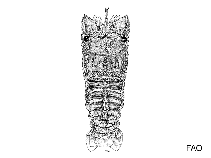
The carapace has the median teeth before the crevical groove blunt and inconspicuous: the rostral tooth is reduced to a tubercle, the pregastric tooth is replaced by a double row of 1 or 2 tubercles and a few inconspicuous median tubercles. The gastric tooth is the most conspicuous, it isbroad and blunt and bears a double row of tubercles. The surface of the carapace is very uneven and the tubercles are high. Between the postrostral and branchial carinae there are a few tubercles and many smooth areas. The abdomen shows a distinct median longitudinal carina on somites 2 to 5, that of somite 3 is by far the highest, and (like the one fo somite 4) bears numerous tubercles laterally. Somite 1 is quite smooth, and has the transverse groove only slightly noticeable in the extreme lateral parts. The exposed part of the following somites show no arborescent pattern, but in each somite there is a wide transverse groove there. In somite 2, both before and behind this groove there is a perfectly smooth broad ridge, a character in which the species differs from most others. In the following somites these ridges are tuberculate. In somites 4 to 6 the posterior margin is tuberculate. The fourth antennal segment has a sharp and high oblique median carina. Outside the carina the upper surface of the segment shows a row of tubercles. The outer margin of the segment bears 4 or 5 teeth (apical tooth of the segment not included), the inner margin has 5 to 7 teeth of irregular size. The anterior margin of the thoracic sternum is deeply U-shapedly incised. Each of the thoracic sternites bears a rounded median tubercle. The dactyli of pereiopods 3 to 5 show two short fringes of hair each. Colour: the dorsal surface of the body is greyish or purplish brown with darker spots. The distal segment of the antenna is often lighter. The first abdominal somite shows dorsally often a dark blue colour (Ref. 252).
It has lengths of 2.5 to 6 cm (males and females) and 3 to 6 cm (ovigerous females), total body length; 0.8 to 2.1 cm (males), 0.8 to 2.2 cm (females) and 1 to 2.2 cm (ovigerous females), carapace length (Ref. 4). Inhabits depths from 20 to 60 m, rarely reported from 100 to 200 m with a bottom usually sand and mud, sometimes with coral, shelly grit or rubble (Ref. 4).
Ciclo vitale e comportamento di accoppiamento
Maturità | Riproduzione | Deposizione | Uova | Fecondità | Larve
Members of the order Decapoda are mostly gonochoric. Mating behavior: Precopulatory courtship ritual is common (through olfactory and tactile cues); usually indirect sperm transfer.
Holthuis, L.B. 1991 FAO Species Catalogue. Vol. 13. Marine lobsters of the world. An annotated and illustrated catalogue of species of interest to fisheries known to date. FAO Fish. Synop. 125(13):292p. Rome: FAO. (Fonte Biblio. 4)
Stato della Lista Rossa IUCN
(Fonte Biblio. 130435: Version 2025-2 (Global))
Stato della CITES (Fonte Biblio. 108899)
Not Evaluated
CMS (Fonte Biblio. 116361)
Not Evaluated
Minaccia per l'uomo
Usi umani
Pesca: di nessun interesse
FAO - Publication: search | FishSource |
Strumenti
Informazioni ulteriori
Ecologia troficaArticoli alimentari (prede)
Alimentazione
Consumo di cibo
Predatori
Dinamica della popolazione Ciclo di vitaRiproduzioneMaturitàFeconditàDeposizioneUovaSviluppo delle uovaLarve FisiologiaConsumo di ossigeno
Legato all'uomoFrancobolli, monete, materiale vario.
Fonti Internet
Stime basate su modelli
Vulnerabilità della pesca
(Fonte Biblio. 71543) |
Low vulnerability (10 of 100). |
Categoria di prezzo
(Fonte Biblio. 80766): |
Very high. |