Malacostraca |
Decapoda |
Scyllaridae
Milieu: milieu / Klimaatzone / Diepte / verspreidingsgebied
Ecologie
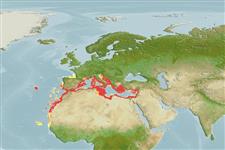
Benthic; diepte 5 - 1200 m (Ref. 4). Subtropical; 46°N - 14°N, 26°W - 36°E (Ref. 4)
Eastern Central Atlantic and the Mediterranean: From the western Mediterranean (Melilla, Spanish Morocco) to the coast of Israel and Cyprus (but not yet reported from the North African coast east of Morocco).
Lengte bij maturiteit / Grootte / Gewicht / Leeftijd
Maturiteit: Lm ? range ? - ? cm Max length : 5.5 cm TL mannelijk / geslacht onbekend; (Ref. 4)
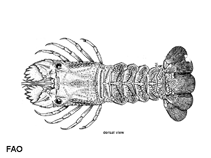
Carapace with three distinct acute teeth in the median line before the cervical groove (the gastric, pregastric and rostral teeth). Region between the postrostral and branchial carinae with only few tubercles and with extensive smooth areas. Abdomen without a sharp elevated median longitudinal carina, but each abdominal somites 2 to 5 with an elongate lobulate figure in the middle. The exposed part of the abdominal somites 2 to 5 with an arborescent arrangement of very narrow grooves. Somite 1 with a complete transverse groove, behind which there are numerous short longitudinal grooves that may be rather irregular in shape and sometimes are interconnected by transverse grooves; this posterior part of somite 1 is no longer in the middle than laterally. The smooth anterior half of abdominal somites 2 to 6 (i.e., the part that disappears under the tergum of the previous somite when the abdomen is fully stretched) on either side with a short transverse groove in which hairs are implanted. Fourth segment of antenna with a single oblique median carina. Outer margin of the segment with 2, the inner margin with 3 or 4 teeth (not including the apical tooth). Thoracic sternum anteriorly U-shapedly incised in the middle. A blunt and low but conical tubercle on the last thoracic sternite. Dactyli of legs without fringes of hair. Colour: pale brownish or pinkish with patches of darker hairs. Two dark spots on the dorsal face of the first abdominal somite in the sibmedian region (Ref. 4).
It has lengths of 5.5 cm, maximum total length, usually not more than 4 cm; 1 cm (males) and 1.15 cm, (females) (Ref. 4). Maximum depth is from Ref. 119076. Occurs at a depth range from 5 to 100 m (Ref. 4).
Levenscyclus en paargedrag
Maturiteit | Voortplanting | Paaien | Eieren | Fecunditeit | Larven
Ovigerous females in June and August.
Holthuis, L.B. 1991 FAO Species Catalogue. Vol. 13. Marine lobsters of the world. An annotated and illustrated catalogue of species of interest to fisheries known to date. FAO Fish. Synop. 125(13):292p. Rome: FAO. (Ref. 4)
Status op de Rode Lijst van het IUCN
(Ref. 130435: Version 2025-2 (Global))
CITES status (Ref. 108899)
Not Evaluated
Not Evaluated
Gevaar voor de mens
Gebruik door de mens
Visserij: van potentieel belang
FAO - Publication: search | FishSource |
Tools
Meer informatie
Trofische ecologieVoedsel (prooien)DieetsamenstellingVoedselconsumptiePredatoren PopulatiedynamicaGroei
Max. leeftijden / maten
Lengte-gewicht rel.
Lengte-lengte rel.
Lengtefrequenties
Massaconversie
Abundantie
LevenscyclusVoortplantingMaturiteitFecunditeitPaaienEierenOntwikkeling van de eierenLarven FysiologieZuurstofverbruik
Menselijk gerelateerdPostzegels, munten, diversen.
Internetbronnen
Schattingen op basis van modellen
Kwetsbaarheid van de visserij
(Ref. 71543) |
Low vulnerability (10 of 100). |
Prijsklasse
(Ref. 80766): |
Very high. |