Malacostraca |
Decapoda |
Scyllaridae
Ambiente: milieu / zona climatica / distribuzione batimetrica / gamma di distribuzione
Ecologia
Benthic; distribuzione batimetrica 0 - 1399 m (Fonte Biblio. 99823), usually 10 - 50 m (Fonte Biblio. 116221). Tropical; 35°N - 28°S, 32°E - 169°E (Fonte Biblio. 4)
Indo-West Pacific.
Lunghezza alla prima maturità / Dimensione / Peso / Età
Maturità: Lm ? range ? - ? cm Max length : 4.0 cm TL maschio/sesso non determinato; (Fonte Biblio. 4); 6 cm TL (female)
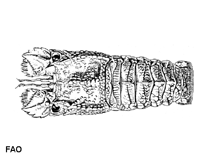
Carapace with two distinct teeth in the median line before the cervical groove (the gastric and pregastric teeth), the rostral tooth is absent, and replaced by an inconspicious tubercle. The region between the postrostral and branchial carinae shows many tubercles, especially in the posterior half of the carapace. The abdomen has a conspicuously elevated longitudinal median carina on somites 2 to 5, that of smite 2 shows as an inverted V-shaped ridge when looked at dorsally. The carina of somite 3 is somewhat higher than the others. Somite 1 shows a complete transverse groove behind which there are about 16 straight , parallel longitudinal unbranched grooves, which are quite characteristic for the species. The other somites show a somewhat arborescent pattern on the exposed part. The fourth segment of the antenna has, apart from the distinct and sharp oblique median carina, an additional short curved carina formed by a row of tubercles; this additional carina is on the outer half of the segment. The outer margin of the segment has 3 to 5 (mostly 3) distinct teeth (apical tooth not included), the inner margin has 5 to 9 teeth, the basal of which is largest. The anterior margin of the thoracic sternum is very shallowly concave, narrowly incised in the middle and with a small tubercle either side of that incision. Sternites 2 to 4 show a faint median tubercle each. The pereiopods show no hairy fringes om the dactyli. Colour: the body is yellowish or reddish brown, somewhat ireegularly marbled. A darker brown transverse band may be present on the third abdominal somite. The leg show a darker band on some of the segments (Ref. 252).
It has lengths of 2 to 4 cm (males), 2 to 6 cm (females) and 2.5 to 4 cm (ovigerous females), total body length; 0.4 to 1.3 cm (males), 0.7 to 2 cm (females) and 0.5 to 1.5 cm (ovigerous females), carapace length (Ref. 4). It inhabits soft and smooth substrates, consisting of sand and/or mud, sometimes with shells, pumice, foraminiferans or bryozoans (Ref. 4). Nistos are found to bury in sandy substrates during the day. Larvae are closely associated with medusae (Ref. 106412).
Ciclo vitale e comportamento di accoppiamento
Maturità | Riproduzione | Deposizione | Uova | Fecondità | Larve
Members of the order Decapoda are mostly gonochoric. Mating behavior: Precopulatory courtship ritual is common (through olfactory and tactile cues); usually indirect sperm transfer.
Holthuis, L.B. 1991 FAO Species Catalogue. Vol. 13. Marine lobsters of the world. An annotated and illustrated catalogue of species of interest to fisheries known to date. FAO Fish. Synop. 125(13):292p. Rome: FAO. (Fonte Biblio. 4)
Stato della Lista Rossa IUCN
(Fonte Biblio. 130435: Version 2025-2 (Global))
Stato della CITES (Fonte Biblio. 108899)
Not Evaluated
CMS (Fonte Biblio. 116361)
Not Evaluated
Minaccia per l'uomo
Usi umani
Pesca: di nessun interesse
FAO - Publication: search | FishSource |
Strumenti
Informazioni ulteriori
Ecologia troficaArticoli alimentari (prede)
Alimentazione
Consumo di cibo
Predatori
Dinamica della popolazione Ciclo di vitaRiproduzioneMaturitàFeconditàDeposizioneUovaSviluppo delle uovaLarve FisiologiaConsumo di ossigeno
Legato all'uomoFrancobolli, monete, materiale vario.
Fonti Internet
Stime basate su modelli
Vulnerabilità della pesca
(Fonte Biblio. 71543) |
Low vulnerability (10 of 100). |
Categoria di prezzo
(Fonte Biblio. 80766): |
Very high. |