Malacostraca |
Decapoda |
Scyllaridae
Entorno: milieu / zona climática / rango de profundidad / gama de distribución
Ecología
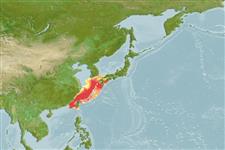
Benthic; rango de profundidad 60 - 504 m (Referencia 4). Subtropical; 35°N - 21°N, 118°E - 134°E (Referencia 4)
Western Pacific.
Longitud en la primera madurez / Tamaño / Peso / Edad
Madurez: Lm ? range ? - ? cm Max length : 1.8 cm CL macho / no sexado; (Referencia 89665); common length : 5.5 cm TL macho / no sexado; (Referencia 4)
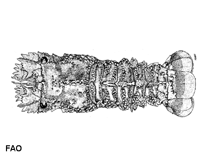
Carapace with 2 distinct teeth in the median line before the cervical groove (the gastric and rostral teeth), the pregastric tooth is absent. The region between the postrostral and branchial carinae with only a few tubercles and extensive smooth areas. Abdominal somites 2 to 5 with distinct elevated median longitudinal carina; the carina of the third somite is distinctly higher than that of the other somites. The exposed part of the somites without arborescent pattern, but with a wide transverse groove over the middle; behind this groove a transverse ridge extends along the posterior margin of the somite; before the groove there are tubercles and some wide side grooves. Somite 1 dorsally smooth with only an indication of a transverse groove in the extreme lateral part. Posterior margin of somites 5 and 6 not tuberculate. Fourth segment of antenna with the median oblique carina distinct but not quite straight; a row of tubercles is present on the outer half of the upper surface of the segment, tubercles are also present in the basal part of the median carina. The outer margin of the fourth segment has 3 or 4 teeth, the basal which is the largest (the apical tooth not included in these counts). The thoracic sternum is widely U-shapedly incised anteriorly; the last 4 sternites show an inconspicuous median tubercle. A dorsal fringe of hairs is present on the dactyli of pereiopods 3 to 5. Colour: dark brown above, tubercles slightly paler, sometimes with whitish areas in the branchial region and along the central part of the cervical groove. A dark blue spot in the median part of the first abdominal somite (Ref. 252).
It has lengths of 4 to 5.5. cm, total body length; 1.3 to 1.8 cm and 1.6 to 1.8 cm (ovigerous females), carapace length (Ref. 4). Maximum depth from Ref. 99823. Occurs at a depth range from 60 to 150 m with substrates of sand or mud (Ref. 4).
Ciclo vital y comportamiento de apareamiento
Madurez | Reproducción | Puesta | Huevos | Fecundidad | Larva
Members of the order Decapoda are mostly gonochoric. Mating behavior: Precopulatory courtship ritual is common (through olfactory and tactile cues); usually indirect sperm transfer.
Holthuis, L.B. 1991 FAO Species Catalogue. Vol. 13. Marine lobsters of the world. An annotated and illustrated catalogue of species of interest to fisheries known to date. FAO Fish. Synop. 125(13):292p. Rome: FAO. (Referencia 4)
Situación en la Lista Roja de la UICN
(Referencia 130435: Version 2025-2 (Global))
Estatus CITES (Referencia 108899)
Not Evaluated
CMS (Referencia 116361)
Not Evaluated
Amenaza para el ser humano
Usos humanos
Pesquerías: sin interés
FAO - Publication: search | FishSource |
Herramientas
Más información
Ecología TróficaAlimentos (presas)
Composición de la dieta
consumo de alimento
Despredadores
Dinámica de la poblaciónCrecimientoEdades / tallas máximasLongitud-peso rel.Longitud-longitud rel.Longitud-frecuenciasConversión de masasAbundancia Ciclo de vidaReproducciónMadurezFecundidadPuestaHuevosDesarrollo de los huevosLarva FisiologíaConsumo del oxígeno
Relacionados con el ser humanoSellos, monedas, varios
Fuentes de Internet
Estimaciones basadas en modelos
Vulnerabilidad pesquera
(Referencia 71543) |
Low vulnerability (10 of 100). |
Categoría de precios
(Referencia 80766): |
Very high. |