Malacostraca |
Decapoda |
Palinuridae
สิ่งแวดล้อม : สิ่งแวดล้อม / เขตภูมิอากาศ / ระดับความลึก / ระยะการกระจายสินค้า
นิเวศวิทยา
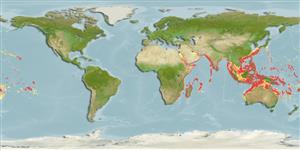
Benthic; ระดับความลึก 0 - 900 m (อ้างอิง 4). Tropical; 35°N - 32°S, 31°E - 134°W (อ้างอิง 4)
Indo-Pacific: from South Africa to Hawaii, including Red Sea and Persian Gulf, from Japan to Australia.
ความยาวเมื่อครบกำหนดครั้งแรก / ขนาด / น้ำหนัก / อายุ
วัยเจริญพันธุ์: Lm 7.8, range 8 - ? cm Max length : 40.0 cm TL เพศผู้/กระเทย; (อ้างอิง 4)
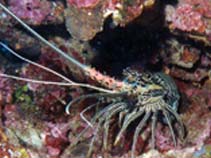
Minimum depth from Ref. 96667. It has a maximum total body length of 40 cm, and an average length less than 30 cm (Ref. 4). Maximum depth from Ref. 105426. It occurs in shallow water, from the sublittoral down to 15 m; in coral reef areas, often on seaward edges of the reef plateau; in clear water also in surf areas. The species is nocturnal and not gregarious; in daytime, it hides in crevices and cavities of the rocks (Refs. 4, 9773). In general, palinurids are mainly considered carnivores, usually feeding upon sluggish, easily captured animals where most material is eaten alive or freshly killed (Ref. 105260). Feeds on bivalve mollusks and sea urchins (Ref. 9773).
วงจรชีวิตและพฤติกรรมการผสมพันธุ์
วัยเจริญพันธุ์ | การสืบพันธุ์ | การวางไข่ | เซลสืบพันธ์ของเพศเมีย(ไข่) | ความดกของไข่ | ตัวอ่อน
Members of the order Decapoda are mostly gonochoric. Mating behavior: Precopulatory courtship ritual is common (through olfactory and tactile cues); usually indirect sperm transfer.
Holthuis, L.B. 1991 FAO Species Catalogue. Vol. 13. Marine lobsters of the world. An annotated and illustrated catalogue of species of interest to fisheries known to date. FAO Fish. Synop. 125(13):292p. Rome: FAO. (อ้างอิง 4)
สถานะบัญชีแดงของ IUCN
(อ้างอิง 130435: Version 2025-2 (Global))
สถานะไซเตส (อ้างอิง 108899)
Not Evaluated
CMS (อ้างอิง 116361)
Not Evaluated
ภัยคุกคามต่อมนุษย์
การใช้ของมนุษย์
การประมง: การค้า
FAO - Publication: search | FishSource | ทะเลรอบๆเรา
เครื่องมือ
ข้อมูลเพิ่มเติม
เกี่ยวข้องกับมนุษย์แสตมป์ เหรียญ อื่นๆ
แหล่งที่มาจากอินเตอร์เน็ต
การประมาณค่าตามแบบจำลอง
ความสามารถในการกลับคืนสู่ปกติ
(Ref. 69278): |
ขนาดกลาง, เวลาต่ำสุดที่จะทำให้ประชากรเพิ่มขึ้นเป็น 2 เท่าใช้เวลา 1.4 - 4.4 ปี (K=0.27; tm=3) |
Rate of population increase
|
Prior r = 1.19, 95% CL = 0.79 - 1.79, Based on 1 data-limited stock assessment. |
ความเสี่ยงต่อการตกปลา
(อ้างอิง 71543) |
Moderate vulnerability (42 of 100). |
หมวดหมู่ราคา
(อ้างอิง 80766): |
Very high. |
Nutrients
|
Calcium = 109 [35, 184] mg/100g; Iron = 1.59 [1.21, 1.97] mg/100g; Protein = 20.2 [19.2, 21.3] %; Omega3 = 0.285 [0.185, 0.386] g/100g; Selenium = 48.3 [-31.7, 128.3] μg/100g; VitaminA = 0 μg/100g; Zinc = 1.79 [1.17, 2.40] mg/100g (wet weight); based on nutrient studies. |