Malacostraca |
Decapoda |
Callichiridae
Environnement : milieu / zone climatique / profondeur / gamme de distribution
Écologie
Benthic; saumâtre. Subtropical; 25°S - 36°S, 16°E - 35°E (Réf. 4)
Southeast Atlantic and Western Indian Ocean: from South Africa to Mozambique.
Longueur à la première maturité / Taille / Poids / Âge
Maturité: Lm ? range ? - ? cmCommon length : 7.0 cm TL mâle / non sexé; (Réf. 4)
Description synthétique
Morphologie
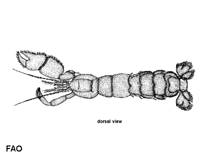
Rostrum broadly triangular, far overeached by the eyes that are oval. Antennal angle low and blunt, without spine. Antennular peduncle much longer than antennal peduncle, which it overreaches with more than half the length of the last segment. Third maxilliped with merus and ischium strongly widened to form a operculum. Carpus somewhat widened, being less than twice as long as wide; propodus strongly widened, being wider than long; dactylus slender. Large chela of adult male with a deep, but rather wide concavity in the anterior margin of the palm above the fixed finger. Carpus about as long as pal, and as long as high. Merus with a rounded lobe in basal part of lower margin. Surface of larger cheliped with numerous tubercles. Telson distinctly wider than long and much shorter than uropods, being only somewhat more than half as long as endopod. Lateral margins of telson convex, posterolateral corners rounded, posterior margin almost straight, without a spine. Endopod of uropod elongate oval (Ref. 4).
It has a total body length of 7 cm (Ref. 4). It is found from littoral zones to 0.5 m deep, in sheltered bays and estuaries; sandy substrate, in which it digs its burrows; usually with a dense population (Ref. 4).
Cycle de vie et comportement reproducteur
Maturité | Reproduction | Frai | Œufs | Fécondité | Larves
Members of the order Decapoda are mostly gonochoric. Mating behavior: Precopulatory courtship ritual is common (through olfactory and tactile cues); usually indirect sperm transfer.
Holthuis, L.B. 1991 FAO Species Catalogue. Vol. 13. Marine lobsters of the world. An annotated and illustrated catalogue of species of interest to fisheries known to date. FAO Fish. Synop. 125(13):292p. Rome: FAO. (Réf. 4)
Statut dans la liste rouge de l'IUCN
(Réf. 130435: Version 2025-2 (Global))
statut CITES (Réf. 108899)
Not Evaluated
Not Evaluated
Menace pour l'homme
Utilisations par l'homme
Appât: usually
FAO - Publication: search | FishSource |
Outils
Plus d'informations
Écologie trophiqueAliments (proies)
Composition du régime alimentaire
Consommation alimentaire
Prédateurs
Dynamique des populationsCroissance
Âges / tailles maximales
Longueur-poids rel.
Rel. longueur-longueur.
Fréquences de longueurs
Conversion de masse
Abondance
Cycle de vieReproductionMaturitéFéconditéFraiŒufsDéveloppement de l'œufLarves PhysiologieConsommation d'oxygène
Liées à l'hommeTimbres, pièces de monnaie, divers
Sources Internet
Estimations basées sur des modèles