Malacostraca |
Decapoda |
Callianassidae
Environnement : milieu / zone climatique / profondeur / gamme de distribution
Écologie
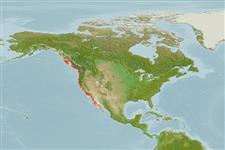
Benthic; saumâtre; profondeur 0 - 110 m (Réf. 101444). Temperate; 60°N - 26°N, 138°W - 112°W (Réf. 4)
Eastern Pacific: from southeast Alaska, USA to San Quintin Bay, Baja California, Mexico and El Coyote Estuary, Point Abreojos Baja California Sur, Mexico. Tropical to temperate.
Longueur à la première maturité / Taille / Poids / Âge
Maturité: Lm ?, range 1 - 1 cm Max length : 11.5 cm TL mâle / non sexé; (Réf. 4)
Description synthétique
Morphologie
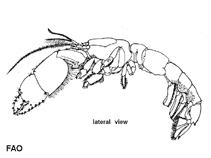
Rostrum hardly noticeable, a slight angle in the anterior margin of the carapace. Eyes triangular reaching with their full length beyond the rostrum. Antennal angles rounded, without spine. Antennal peduncle somewhat shorter than antennular. Third maxilliped with merus and ischium strongly widened to an operculum; last three segments far narrower, each about twice as long as wide. Large chela of adult male with a distinct concavity the anterior margin of the palm above the base of the fixed finger; this concavity absent or inconspicuous in female and juvenile males. Carpus about as long as the palm, and about as high as long. Merus with a distinct broad and bluntly truncated process in the basal part of the lower margin; in the female this process is more in the shape of triangular tooth. Telson about quadrangular, longer than wide and slightly and gradually narrowing posteriorly; the posterolateral angles are broadly rounded; the posterior margin shows a small triangular tooth in the middle; other teeth or spines are present. Endopod of uropod squarish with rounded angles, slightly longer than the telson (Ref. 4).
Assumed total body length is 11.5 cm (Ref. 4). Found in tidal flats of sand and mud on the sea coasts and in estuarine areas. Forms burrows in soft substrates (Ref. 4). Primarily feeds on plankton and sediment detritus obtained from burrowing. Regularly burrows to find food, re-tunneling up to a depth of 76 cm (Ref. 101553).
Mating behavior: Precopulatory courtship ritual is common (through olfactory and tactile cues); usually indirect sperm transfer (Ref. 833).
Holthuis, L.B. 1991 FAO Species Catalogue. Vol. 13. Marine lobsters of the world. An annotated and illustrated catalogue of species of interest to fisheries known to date. FAO Fish. Synop. 125(13):292p. Rome: FAO. (Réf. 4)
Statut dans la liste rouge de l'IUCN
(Réf. 130435: Version 2025-2 (Global))
statut CITES (Réf. 108899)
Not Evaluated
Not Evaluated
Menace pour l'homme
Utilisations par l'homme
Pêcheries: commercial; appât: usually
FAO - Publication: search | FishSource |
Outils
Plus d'informations
Dynamique des populations Liées à l'hommeTimbres, pièces de monnaie, divers
Sources Internet
Estimations basées sur des modèles
Vulnérabilité de la pêche
(Réf. 71543) |
Low vulnerability (17 of 100). |
Catégorie de prix
(Réf. 80766): |
Unknown. |