Gastropoda |
Not assigned |
Potamididae
Environnement : milieu / zone climatique / profondeur / gamme de distribution
Écologie
Benthic. Tropical
Western Pacific.
Longueur à la première maturité / Taille / Poids / Âge
Maturité: Lm ? range ? - ? cm
Description synthétique
Morphologie
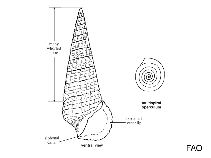
Shell high, with 10 to whorls, flat sided. Two channels and an impressed suture can be found on the upper whorls, and about 10 channels on the body whorl are crossed by axial ribs, producing squarish beads. Beads on each whorl are all of similar size. Outer lip is flared in aduls, and thickened with both anterior and posterior canals. Columella is smooth, and thickened along full height. Shell is dark brown. Aperture is whitish. Operculum is light brown and horny.
Found in sandy shores, near the vicinity of the depression formed during low tides to avoid desiccation (Ref. 125338). On mud or rock surfaces in mangroves, at the mid to upper intertidal levels (Ref. 128877). Part of both epibenthic and arboreal communities (Ref. 128397).
Cycle de vie et comportement reproducteur
Maturité | Reproduction | Frai | Œufs | Fécondité | Larves
Members of the order Neotaenioglossa are mostly gonochoric and broadcast spawners. Life cycle: Embryos develop into planktonic trocophore larvae and later into juvenile veligers before becoming fully grown adults.
Poppe, G.T. 2008 Philippine marine mollusks. Vol. 1 (Gastropoda - Part 1). ConchBooks. 759 p. (Réf. 86518)
Statut dans la liste rouge de l'IUCN
(Réf. 130435: Version 2025-2 (Global))
statut CITES (Réf. 108899)
Not Evaluated
Not Evaluated
Menace pour l'homme
Utilisations par l'homme
FAO - Publication: search | FishSource |
Outils
Plus d'informations
Écologie trophiqueAliments (proies)
Composition du régime alimentaire
Consommation alimentaire
Prédateurs
Dynamique des populationsCroissanceÂges / tailles maximalesLongueur-poids rel.Rel. longueur-longueur.Fréquences de longueursConversion de masseAbondance Cycle de vieReproductionMaturitéFéconditéFraiŒufsDéveloppement de l'œufLarves PhysiologieConsommation d'oxygène
Liées à l'hommeTimbres, pièces de monnaie, divers
Sources Internet
Estimations basées sur des modèles
Vulnérabilité de la pêche
(Réf. 71543) |
(0 of 100). |