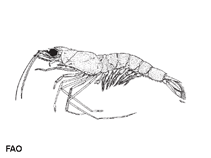
Malacostraca |
Decapoda |
Solenoceridae
Milieu: milieu / Klimaatzone / Diepte / verspreidingsgebied
Ecologie
Benthic, usually 75 - 350 m (Ref. 409). Tropical; 46°N - 26°S, 39°E - 141°E
Indo-West Pacific and Atlantic Ocean: from eastern coast of Africa to Japan and Indonesia.
Lengte bij maturiteit / Grootte / Gewicht / Leeftijd
Maturiteit: Lm ? range ? - ? cm Max length : 6.5 cm BASL mannelijk / geslacht onbekend; (Ref. 409)
Carapace length of maximum BL: 2.2 cm; Common body length: 3-5.5 cm.
Occurs on bottoms of sand and/or mud at depths of 75 to 350 m, usually deeper than 175 m (Ref. 409). Depth estimate based on Family.
Levenscyclus en paargedrag
Maturiteit | Voortplanting | Paaien | Eieren | Fecunditeit | Larven
Members of the order Decapoda are mostly gonochoric. Mating behavior: Precopulatory courtship ritual is common (through olfactory and tactile cues); usually indirect sperm transfer.
Chan, T.Y. 1998 Shrimps and prawns. 851-971. In Carpenter, K.E. and V.H.Niem (eds). FAO species identification guide for fishery purposes. The living marine resources of the Western Central Pacific. Vol. 2. Cephalopods, crustaceans, holothurians and sharks. Rome, FAO. 687-1396. (Ref. 409)
Status op de Rode Lijst van het IUCN
(Ref. 130435: Version 2025-2 (Global))
CITES status (Ref. 108899)
Not Evaluated
Not Evaluated
Gevaar voor de mens
Gebruik door de mens
Visserij: van geen belang
FAO - Publication: search | FishSource |
Tools
Meer informatie
Trofische ecologieVoedsel (prooien)
Dieetsamenstelling
Voedselconsumptie
Predatoren
PopulatiedynamicaGroei
Max. leeftijden / maten
Lengte-gewicht rel.
Lengte-lengte rel.
Lengtefrequenties
Massaconversie
Abundantie
LevenscyclusVoortplantingMaturiteitFecunditeitPaaienEierenOntwikkeling van de eierenLarven FysiologieZuurstofverbruik
Menselijk gerelateerdPostzegels, munten, diversen.
Internetbronnen
Schattingen op basis van modellen
Kwetsbaarheid van de visserij
(Ref. 71543) |
Low vulnerability (10 of 100). |
Prijsklasse
(Ref. 80766): |
Unknown. |