-

- About this page
- Languages
-
Feedback
- Citation
- Upload
-
Related species
- Species in
Favites - Species in
Merulinidae - - Classification -
- Merulinidae
- Scleractinia
- Hexacorallia
- Chordata
- Animalia
- Species in
-



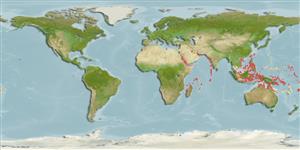
Favites acuticollis (Ortmann, 1889)
| Native range | All suitable habitat | Point map | Year 2050 |
|
| This map was computer-generated and has not yet been reviewed. |
| Favites acuticollis AquaMaps Data sources: GBIF OBIS |
Upload your photos
Google image |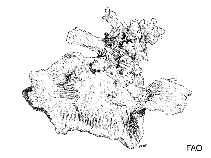 No image available for this species;
drawing shows typical species in Merulinidae.
Google image |
drawing shows typical species in Merulinidae.
Classification / Names Common names | Synonyms | CoL | ITIS | WoRMS
Hexacorallia | Scleractinia | Merulinidae
Environment: milieu / climate zone / depth range / distribution range Ecology
Reef-associated; depth range 0 - 20 m (Ref. 98471). Tropical
Distribution Countries | FAO areas | Ecosystems | Occurrences | Introductions
Northwest and Western Central Pacific: Hong Kong, Malaysia and Indonesia.
Length at first maturity / Size / Weight / Age
Maturity: Lm ? range ? - ? cm
Short description Morphology
Colony: submassive to encrusting. Corallites: deep, with very thin angular walls giving colonies a honeycomb appearance. Corallites: usually less than 7 mm across. Septa: few, widely spaced. Absent paliform lobes. Colors dark, often with white upper margins to walls (Ref. 848).
Occurs in shallow reef environments (Ref. 848). In lagoons and on the back and foreslope of the reef (Ref. 98471).
Life cycle and mating behavior Maturity | Reproduction | Spawning | Eggs | Fecundity | Larvae
Members of the class Anthozoa are either gonochoric or hermaphroditic. Mature gametes are shed into the coelenteron and spawned through the mouth. Life cycle: The zygote develops into a planktonic planula larva. Metamorphosis begins with early morphogenesis of tentacles, septa and pharynx before larval settlement on the aboral end.
Main reference
References | Coordinator | Collaborators
Wijsman-Best, M. 1976 Biological results of the Snellius Expedition XXVII, Faviidae collected by the Snellius Expedition. II. The genera Favites, Goniastrea, Platygyra, Oulophyllia, Leptoria, Hydnophora and Caulastrea. Zoologische Medelingen 50(4):45-63. (Ref. 83538)
IUCN Red List Status
(Ref. 130435: Version 2025-1)
Least Concern (LC) ; Date assessed: 24 October 2023
CITES status (Ref. 108899)
Appendix II: International trade monitored
CMS (Ref. 116361)
Not Evaluated
Threat to humans
Harmless
Human uses
| FishSource |
Tools
More information
Trophic Ecology
Food items (preys)
Diet composition
Food consumption
Predators
Diet composition
Food consumption
Predators
Ecology
Population dynamics
Growth
Max. ages / sizes
Length-weight rel.
Length-length rel.
Length-frequencies
Mass conversion
Abundance
Max. ages / sizes
Length-weight rel.
Length-length rel.
Length-frequencies
Mass conversion
Abundance
Life cycle
Distribution
Physiology
Oxygen consumption
Human Related
Stamps, coins, misc.
Outreach
References
Internet sources
BHL | BOLD Systems | CISTI | DiscoverLife | FAO(Publication : search) | Fishipedia | GenBank (genome, nucleotide) | GloBI | Gomexsi | Google Books | Google Scholar | Google | PubMed | Tree of Life | Wikipedia (Go, Search) | Zoological Record
Estimates based on models
Preferred temperature
(Ref. 115969): 27.1 - 29.2, mean 28.8 (based on 626 cells).