Holothuroidea |
Holothuriida |
Holothuriidae
Milieu: milieu / Klimaatzone / Diepte / verspreidingsgebied
Ecologie
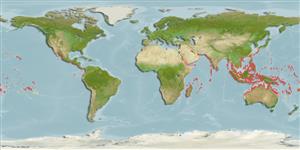
Benthic; diepte 0 - 20 m (Ref. 81020). Tropical
Indo-West Pacific.
Lengte bij maturiteit / Grootte / Gewicht / Leeftijd
Maturiteit: Lm ? range ? - ? cm Max length : 35.0 cm TL mannelijk / geslacht onbekend; (Ref. 92930)
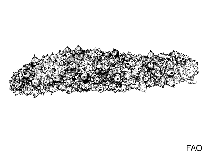
Found on sandy areas (Ref. 115900) surrounded by corals (Ref. 129602). During the day, this species is found under rubble on reef flats, while at night it starts being exposed and becoming active. Disturbance causes this species to eject copious amounts of Cuvierian tubules (Ref. 85218). Conveyor belt-feeder (Ref. 108108), meaning it ingests the substrate's surface and defecates on it (Ref. 115242). Inserts itself in cavities beneath coral colonies during the day along with other Holothuroids (Ref. 129602).
Levenscyclus en paargedrag
Maturiteit | Voortplanting | Paaien | Eieren | Fecunditeit | Larven
Members of the class Holothuroidea are gonochoric and have only one gonad. Spawning and fertilization are both external and some exhibit brooding. Life cycle: Embryos develop into planktotrophic larvae (auricularia) then into doliolaria (barrel-shaped stage) which later metamorphose into juvenile sea cucumbers.
Hartati, S.T., I.S. Wahyuni and U.N. Badri 2050 Jenis-Jenis Teripang Di Indonesia: Sea Cucumber species of Indonesia. Research Institute for Marine Fisheries. (Ref. 75656)
Status op de Rode Lijst van het IUCN
(Ref. 130435: Version 2025-2 (Global))
CITES status (Ref. 108899)
Not Evaluated
Not Evaluated
Gevaar voor de mens
Harmless
Gebruik door de mens
Visserij: commercieel
FAO - Publication: search | FishSource |
Tools
Meer informatie
Trofische ecologieVoedsel (prooien)
Dieetsamenstelling
Voedselconsumptie
Predatoren
LevenscyclusVoortplantingMaturiteitFecunditeitPaaienEierenOntwikkeling van de eierenLarven FysiologieZuurstofverbruik
Menselijk gerelateerdPostzegels, munten, diversen.
Internetbronnen
Schattingen op basis van modellen
Kwetsbaarheid van de visserij
(Ref. 71543) |
Low vulnerability (25 of 100). |