Malacostraca |
Decapoda |
Portunidae
Ambiente: milieu / zona climática / intervalo de profundidade / gama de distribuição
Ecologia
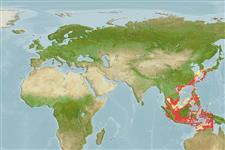
Associadas(os) a recifes; estuarina; intervalo de profundidade 0 - 65 m (Ref. 111223). Tropical, preferred 26°C (Ref. 107945); 35°N - 15°S, 99°E - 137°E
Indo-West Pacific: from China, Japan and Korea to Philippines and westwards to the straits of Malaccca, also present in the Northern Territory, Australia. Tropical to subtropical.
Comprimento na primeira maturidade / Tamanho / Peso / Idade
Maturidade: Lm 6.5, range 6 - ? cm Max length : 20.0 cm CW macho/indeterminado; (Ref. 343)
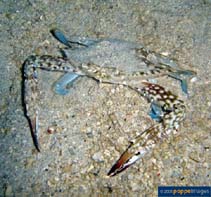
Carapace rough to granulose, regions discernible; front with 4 acutely triangular teeth; 9 teeth on each anterolateral margin, the last tooth 2 to 4 times larger than preceding teeth. Chelae elongate in males; larger chela with conical tooth at base of fingers; pollex ridged. Color: males with blue markings, females dull green.
Matures at about 1 year. Collected mainly by artisanal traps, trawls, beach seines, cylindrical wire traps, folding traps, pots, hop nets, drop nets, and sunken crab gill nets. In shallow waters, it is caught using beach seines, rakes, and dab nets. Sold in local markets (fresh or frozen) and for the crab-flesh canning industry. Most widely sold in markets of Southeast Asia, including the Philippines (Ref. 343). Maximum depth from Ref. 801. Immediate subtidal to a depth of 40 m (Ref. 801), on sandy to sandy-muddy substrates in areas near reefs, mangroves, and sea grass and algal beds (Ref. 343). Juveniles tend to occur in shallow intertidal areas (Ref. 343). Burrows in sand when disturbed; carnivorous and voracious predator (Ref. 801). Host to protozoans, helminths and crustaceans (Ref. 104981).
Members of the order Decapoda are mostly gonochoric. Mating behavior: Precopulatory courtship ritual is common (through olfactory and tactile cues); usually indirect sperm transfer.
Ng, P.K.L. 1998 Crabs. p. 1045-1155. In K.E. Carpenter and V.H. Niem (eds) FAO species identification guide for fishery purposes. The living marine resources of the Western Central Pacific. Volume 2. Cephalopods, crustaceans, holothurians and sharks. Rome, FAO. 1998. pp. 687-1396. (Ref. 343)
Categoria na Lista Vermelha da IUCN
(Ref. 130435: Version 2025-2 (Global))
Categoria CITES (Ref. 108899)
Not Evaluated
Not Evaluated
Ameaça para o homem
Poisonous to eat (Ref. 130554)
Utilização humana
Pescarias: altamente comercial
FAO - Aquaculture Systems: production searchpescarias: perfil da espécie, landings search; Publication: search | FishSource | Sea Around Us
Ferramentas
Mais informação
FisiologiaConsumo de oxigénio
Relacionado com o ser humanoSelos, moedas, diversos.
Fontes da internet
Estimativas baseadas em modelos
Resiliência
(Ref. 69278): |
Elevada, tempo mínimo de duplicação da população menor que 15 meses (K=0.1-3.11) |
Rate of population increase
|
Prior r = 1.19, 95% CL = 0.78 - 1.78, Based on 22 data-limited stock assessments. |
Vulnerabilidade da pesca
(Ref. 71543) |
Low vulnerability (10 of 100). |
Vulnerabilidade climática
(Ref. 125649) |
Low to moderate vulnerability (34 of 100) |
Categoria de preço
(Ref. 80766): |
Very high. |
Nutrients
|
Calcium = 109 [35, 184] mg/100g; Iron = 1.59 [1.21, 1.97] mg/100g; Protein = 20.2 [19.2, 21.3] %; Omega3 = 0.285 [0.185, 0.386] g/100g; Selenium = 48.3 [-31.7, 128.3] μg/100g; VitaminA = 0 μg/100g; Zinc = 1.79 [1.17, 2.40] mg/100g (wet weight); based on nutrient studies. |