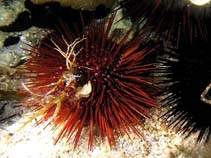
Echinoidea |
Camarodonta |
Echinidae
Ambiente: milieu / zona climatica / distribuzione batimetrica / gamma di distribuzione
Ecologia
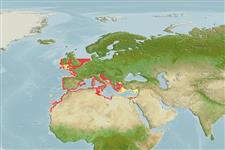
Benthic; distribuzione batimetrica 0 - 90 m (Fonte Biblio. 85345). Tropical, preferred 17°C (Fonte Biblio. 107945); 55°N - 21°N, 17°W - 36°E
Eastern Atlantic and the Mediterranean: from UK Scotland to West Sahara, and east to Lebanon. Subtropical and temperate.
Lunghezza alla prima maturità / Dimensione / Peso / Età
Maturità: Lm ? range ? - ? cm Max length : 6.0 cm WD maschio/sesso non determinato; (Fonte Biblio. )
Feeds on marine plants and animal material (Ref. 113042).
Ciclo vitale e comportamento di accoppiamento
Maturità | Riproduzione | Deposizione | Uova | Fecondità | Larve
Members of the class Echinoidea are gonochoric. Fertilization is external. Brooding is common, eggs are held either on the peristome, around the periproct or deep into the concavities on the petaloids. Life cycle: Embryos develop into planktotrophic larvae (echinoplateus) and live for several months before they sink to the bottom using their tube feet to adhere on the ground where they metamorphose into young urchins.
Koukouras, A. and M.-S. Kitsos 2010 Echinoderms. pp.288-296 In Coll, M., et al., 2010. The biodiversity of the Mediterranean Sea: estimates, patterns, and threats. PLoS ONE 5(8):36pp. (Fonte Biblio. 85345)
Stato della Lista Rossa IUCN
(Fonte Biblio. 130435: Version 2025-2 (Global))
Stato della CITES (Fonte Biblio. 108899)
Not Evaluated
CMS (Fonte Biblio. 116361)
Not Evaluated
Minaccia per l'uomo
Usi umani
Pesca: commerciale
FAO - Aquaculture Systems: production searchpesca: landings search; Publication: search | FishSource | Sea Around Us
Strumenti
Informazioni ulteriori
Dinamica della popolazioneAccrescimento
Età massima / dimensioni massime
Rapporto lunghezza-peso.
Lunghezza-lunghezza rel.
Lunghezza-frequenze
Conversione di massa
Abbondanza
Ciclo di vitaRiproduzioneMaturitàFeconditàDeposizioneUovaSviluppo delle uovaLarve FisiologiaConsumo di ossigeno
Fonti Internet
Stime basate su modelli
Vulnerabilità della pesca
(Fonte Biblio. 71543) |
Low vulnerability (10 of 100). |
Vulnerabilità climatica
(Fonte Biblio. 125649) |
Moderate to high vulnerability (51 of 100) |
Categoria di prezzo
(Fonte Biblio. 80766): |
High. |
Nutrients
|
Calcium = 126 [75, 177] mg/100g; Iron = 5.08 [1.67, 7.92] mg/100g; Protein = 12%; Omega3 = 0.331 [0.263, 0.400] g/100g; Selenium = 0.04 [48.48, 67.17] μg/100g; VitaminA = 0 μg/100g; Zinc = 1.97 [0.92, 3.02] mg/100g (wet weight); based on nutrient studies. |