Cephalopoda |
Myopsida |
Loliginidae
Ambiente: milieu / zona climática / intervalo de profundidade / gama de distribuição
Ecologia
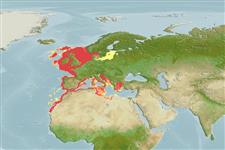
Demersal; intervalo de profundidade 0 - 630 m (Ref. 101472), usually 20 - 200 m (Ref. 275). Subtropical; 62°N - 20°N, 18°W - 37°E (Ref. 107401)
Eastern Atlantic and the Mediterranean: In the northeast Atlantic and Mediterranean between 20° and 60° N.
Comprimento na primeira maturidade / Tamanho / Peso / Idade
Maturidade: Lm 7.8, range 3 - 12.8 cm Max length : 21.5 cm ML macho/indeterminado; (Ref. 104052); 15 cm ML (female); Idade máx. registada: 1.00 anos (Ref. 275)
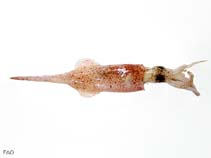
Juveniles develop a bullet-shaped body, have paddle-shaped terminal fins from a simple point at the tip, and the apex later extends into a tail. Adults are typical myopsid squid, with a long muscular mantle and well-defined fins, fins originate in the posterior mantle and extend to the apex, fin width is at least 25% of ML, longest arm is 20-25% of ML, tentacles are considerably shorter than the head and mantle with narrow clubs that have pairs of central suckers attached obliquely to the club axis at an angle, suckers are biserial on the arms, and in four rows on the narrow tentacular clubs tentacle club arrangement is similar in juveniles and adults with suckers of the median rows 3-4 times larger than those of the marginal rows, median suckers are attached obliquely at a 45 degree angle, left ventral arm (IV) is hectocotylized in mature males, 6-8 pairs of proximal suckers which are unmodified and two distal longitudinal rows of fine papillae.
Max length of female from Ref. 275. Females grow bigger than males (Ref. 3722). Neritic, demersal (Ref. 104428). Common in shallow waters (Ref. 104148). Found in the continental shelf (Ref. 104149), shelf break front (Ref. 122864) and upper/middle slope (Ref. 105634). Recorded in subtidal Zostera marina meadows (Ref. 113974). Mainly feeds on small fish (Ref. 104428), also feeds on amphipods, copepods, decapods, euphausiids and mysids (Ref. 107015). Preyed upon by seabird, marine mammals, fish and squids (Ref. 104428).
Members of the class Cephalopoda are gonochoric. Male and female adults usually die shortly after spawning and brooding, respectively. Mating behavior: Males perform various displays to attract potential females for copulation. During copulation, male grasp the female and inserts the hectocotylus into the female's mantle cavity where fertilization usually occurs. Life cycle: Embryos hatch into planktonic stage and live for some time before they grow larger and take up a benthic existence as adults (Ref. 833). Males mature earlier than females (Ref. 104428).
Roper, C.F.E., M.J. Sweeney and C.E. Nauen 1984 FAO Species Catalogue. Vol. 3. Cephalopods of the world. An annotated and illustrated catalogue of species of interest to fisheries. FAO Fish. Synop. 125(3):277p. Rome: FAO. (Ref. 275)
Categoria na Lista Vermelha da IUCN
(Ref. 130435: Version 2025-2 (Global))
Categoria CITES (Ref. 108899)
Not Evaluated
Not Evaluated
Ameaça para o homem
Utilização humana
Pescarias: espécies comerciais
FAO - Publication: search | FishSource |
Ferramentas
Mais informação
FisiologiaConsumo de oxigénio
Relacionado com o ser humanoSelos, moedas, diversos.
Fontes da internet
Estimativas baseadas em modelos
Resiliência
(Ref. 69278): |
Médio, tempo mínimo de duplicação da população 1,4 - 4,4 anos (K=0.2-0.27; tmax=1) |
Vulnerabilidade da pesca
(Ref. 71543) |
Low to moderate vulnerability (29 of 100). |
Categoria de preço
(Ref. 80766): |
High. |