Bivalvia |
Ostreida |
Isognomonidae
Ambiente: milieu / zona climática / intervalo de profundidade / gama de distribuição
Ecologia
Benthic; intervalo de profundidade 0 - 20 m (Ref. 348). Tropical
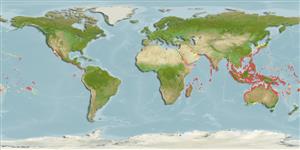
Indo-Pacific: from East Africa, to eastern Polynesia; north to southern Japan and south to Queensland.
Comprimento na primeira maturidade / Tamanho / Peso / Idade
Maturidade: Lm ? range ? - ? cm Max length : 15.0 cm ShL macho/indeterminado; (Ref. 348); common length : 10.0 cm SL macho/indeterminado; (Ref. 348)
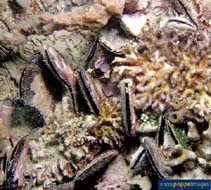
Shell relatively high and narrow in outline, with undulating commissure and strong posteroventral elongation. Shape often very irregular, due to the confined space in which the shell grows and to the effect of repair. Dorsal margin long and straight to slightly arched, more or less strongly expanded posteriorly in a wing-like ear that increases with growth and may attain a size double the length of shell. Anterior margin elongated, markedly sinuous dorsally and extending a little or not at all forward of umbones. Posterior margin concave near the posterior ear, then more or less parallel to anterior margin. Ventral margin roughly rounded. Umbones small, pointing at anterior end of dorsal margin. Outer surface with irregularly concentric lamellate processes, often encrusted with marine growths and corroded towards the umbones. Ligamental area with numerous transverse grooves (more than 20 in large specimens). Nacreous area of the inner side of shell more or less expanded ventrally, its margin often poorly defined. Colour: outside of shell bluish purple to almost black, often paler to whitish umbonally. Interior porcelaneous and similarly coloured on non-nacreous area; nacreous area much paler, with bluish purple hue.
Byssally attached to hard substrates, with the shell vertically disposed and the dorsal margin lying on the rock surface, or to boulders and corals. Often occurs in dense colonies (maximum recorded density of about 870 individuals/m2), sometimes forming mixed natural beds with Malleus regula. Littoral and sublittoral (Ref. 348).
Ciclo de vida e comportamento de acasalamento
Maturidade | Reprodução | Desova | Ovos | Fecundidade | Larvas
Members of the class Bivalvia are mostly gonochoric, some are protandric hermaphrodites. Life cycle: Embryos develop into free-swimming trocophore larvae, succeeded by the bivalve veliger, resembling a miniature clam.
Poutiers, J.M. 1998 Bivalves. Acephala, Lamellibranchia, Pelecypoda. p. 123-362. In Carpenter, K. E. and V. H. Niem. 1998. FAO species identification guide for fishery purposes. The living marine resources of the Western Central Pacific. Volume 1. Seaweeds, corals, bivalves, and gastropods. Rome, FAO. (Ref. 348)
Categoria na Lista Vermelha da IUCN
(Ref. 130435: Version 2025-2 (Global))
Categoria CITES (Ref. 108899)
Not Evaluated
Not Evaluated
Ameaça para o homem
Harmless
Utilização humana
FAO - Publication: search | FishSource |
Ferramentas
Mais informação
Ecologia TróficaProdutos alimentares (presas)
Composição da dieta
Consumo alimentar
Predadores
Dinâmica das populaçõesCrescimentoIdades / tamanhos máximosComprimento-peso rel.Comprimento-comprimento rel.Frequência de comprimentoConversão de massaAbundância Ciclo de vidaReproduçãoMaturidadeFecundidadeDesovaOvosDesenvolvimento dos ovosLarvas FisiologiaConsumo de oxigénio
Relacionado com o ser humanoSelos, moedas, diversos.
Fontes da internet
Estimativas baseadas em modelos
Vulnerabilidade da pesca
(Ref. 71543) |
Low vulnerability (10 of 100). |
Categoria de preço
(Ref. 80766): |
Unknown. |