Tursiops truncatus, Bottlenose dolphin : fisheries, bait
Advertisement

You can sponsor this page

Tursiops truncatus   (Montagu, 1821)

Bottlenose dolphin

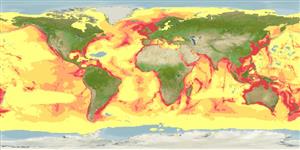
Native range | All suitable habitat | Point map | Year 2050
This map was computer-generated and has not yet been reviewed.
Tursiops truncatus  AquaMaps  Data sources: GBIF OBIS
上傳你的 相片 
所有照片 | Google 影像 |
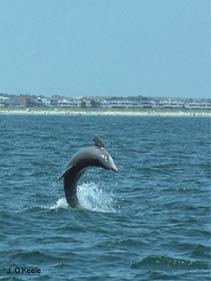
Image of Tursiops truncatus (Bottlenose dolphin)
Tursiops truncatus
Picture by O'Keefe, Jo

分類 / 名稱 俗名 | 同種異名 | CoL | ITIS | WoRMS

Mammalia | Cetartiodactyla | Delphinidae

環境: 環境 / 氣候帶 / 深度上下限 / 配送範圍 生態學

大洋性; 海洋洄游的 (參考文獻 75906); 深度上下限 0 - 1316 m (參考文獻 116169).  Subtropical

分布 Territories | FAO區域 | 生態系 | 發現紀錄 | 簡介

096675 Tursiops truncatus ponticus Endemic to Black Sea.int

初熟時的長度 / 大小 / 重量 / 年齡

成熟度: Lm ?, range 240 - 260 cm Max length : 380 cm TL 雄魚/尚未辨別雌雄; (參考文獻 1394); 最大體重: 650.0 kg (參考文獻 1394)

簡短描述 型態特徵

This coastal subspecies (Tursiops truncatus geyphyreus) can be distinguished from the nominate offshore subspecies (Tursiops truncatus truncatus) by the following diagnosable cranial features: W-shaped border of the antorbital notch (vs. U-shaped); barely or not visible interparietal bone (vs. clearly visible); cranial vertex from the posterior end of nasals to the nuchal crest is short and rectangular (vs. long and squared); left nasal bone noticeably smaller and more compressed antero-posteriorly than the right (vs. nearly symmetrical); Falciform lateral margin of the ascending process of right premaxilla (vs. straight or slightly concave); lateral margin of the ascending process of the maxillae over the preorbital process is deflected dorsally (vs. flat) (Ref. 128824).

生物學特性     字彙 (例如 附生動物)

Preyed upon by great white sharks (Ref. 32140). Dolphins are directly caught for use as shark-bait in Sta. Ana and Aparri, Philippines (Ref. 77119). Found primarily in coastal and inshore regions of tropical and temperate waters of the world (Ref. 936) and deeper channels between islands (Ref. 122680). Also inhabits pelagic waters, such as those in the eastern tropical Pacific (Ref. 936). In herds of less than 20 individuals (Ref. 801). Feeds either cooperatively or in solitary. They can obtain prey via 'fish whacking' and steering fish onto mudflats (Ref. 122680). Feeds on fish (Refs. 801, 936) crustaceans, and cephalopods (Ref. 801).

生命週期和交配行為 成熟度 | 繁殖 | 產卵場 | | 孕卵數 | 仔魚

主要參考資料 參考文獻 | 合作者 | 合作者

Tan, J.M.L. 1995 A Field Guide to the Whales and Dolphins in the Philippines. Makati City: Bookmark. 125 p. (參考文獻 936)

IUCN 瀕危狀態 (參考文獻 130435: Version 2025-2 (Global))

  未評估 

CITES狀態 (參考文獻 108899)


CMS (參考文獻 116361)


對人類具威脅

人類使用

漁業: 商業性; 誘餌: usually
FAO - 漁業: 魚種描繪, landings search; Publication: search | FishSource | 周邊海洋

工具

更多資訊

生命週期
繁殖
成熟度
孕卵數
產卵場

卵發育
仔魚
生理學
耗氧量
人類相關
郵票、錢幣、雜項
外展服務
分類學
參考文獻

網路資源

BHL | BOLD Systems | CISTI | DiscoverLife | FAO - 漁業: 魚種描繪, landings search; Publication: search | Fishipedia | GenBank (基因組, 核甘) | GloBI | Gomexsi | Google Books | Google Scholar | Google | PubMed | 樹狀分類階層 | Wikipedia (, 搜尋) | 動物學的記錄

基於模型的估計

回復力
(Ref. 69278):
高度, 族群倍增時間少於 15個月 (K=0.14-0.48; tm=8.5)
釣魚的脆弱性
(參考文獻 71543)
Very high vulnerability (76 of 100).
價格種類
(參考文獻 80766):
Unknown.