Malacostraca |
Decapoda |
Portunidae
Environment: milieu / climate zone / depth range / distribution range
Ecology
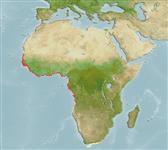
Benthic; depth range 1 - 55 m (Ref. 435), usually 10 - 30 m (Ref. 435). Tropical; 34°N - 17°S, 26°W - 14°E
Eastern Atlantic: from Madeira Islands, south to Cape Verde and Angola.
Length at first maturity / Size / Weight / Age
Maturity: Lm ? range ? - ? cm Max length : 9.3 cm CL male/unsexed; (Ref. 435)
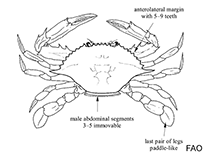
Maximum carapace width: 19.0 cm (Ref. 435). Also caught by trammel nets (Ref. 417). Occurs at depths from 1 to 55 m, common at depths of 10 to 30 m. Inhabits shallow coastal waters with bottoms consisting of sand or mud (Ref. 435).
Life cycle and mating behavior
Maturity | Reproduction | Spawning | Eggs | Fecundity | Larvae
Members of the order Decapoda are mostly gonochoric. Mating behavior: Precopulatory courtship ritual is common (through olfactory and tactile cues); usually indirect sperm transfer.
Fischer, W., G. Bianchi and W.B. Scott (eds.) 1981 True Crabs. 6: pag.var. In FAO species identification sheets for fishery purposes. Eastern Central Atlantic (fishing areas 34, 47; in part). Canada Funds-in-Trust. Ottawa, Department of Fisheries and Oceans Canada, by arrangement with the Food and AgriculturesOrganization of the United Nations, 1-7: pag.var. (Ref. 435)
IUCN Red List Status
(Ref. 130435: Version 2025-2 (Global))
CITES status (Ref. 108899)
Not Evaluated
Not Evaluated
Threat to humans
Harmless
Human uses
Fisheries: commercial
FAO - Publication: search | FishSource |
Tools
More information
Trophic EcologyFood items (preys)
Diet composition
Food consumption
Predators
Life cycleReproductionMaturityFecunditySpawningEggsEgg developmentLarvae PhysiologyOxygen consumption
Human RelatedStamps, coins, misc.
Internet sources
Estimates based on models
Fishing Vulnerability
(Ref. 71543) |
Low vulnerability (10 of 100). |
Price category
(Ref. 80766): |
High. |