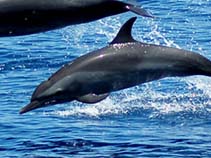
Mammalia |
Cetartiodactyla |
Delphinidae
Lingkungan: lingkungan / zona iklim / kisaran kedalaman / jangkauan distribusi
Ekologi
Pelagis, permukaan; oceanodromus (Acuan 75906); kisaran kedalaman 0 - 5300 m (Acuan 116169). Tropical; 22°C - ? (Acuan 75906); 90°N - 90°S, 180°W - 180°E
Atlantic Ocean and Indo-Pacific: Stenella attenuata graffmani: Gulf of California and Colombia; Stenella attenuata subspecies A: Hawaii; Stenella attenuata subspecies B: Baja California Sur, Colombia. Tropical to temperate.
Panjang pada saat jatuh tempo pertama / Ukuran / Berat / umur
Kematangan: Lm 182.0 range ? - ? cm Max length : 260 cm TL jantan/; (Acuan 1394); 240 cm TL (female); Berat maksimum terpublikasi: 120.0 kg (Acuan 1394)
Major threats to this species is incidental catches specifically by tuna fishermen in the eastern Pacific, and as sustainable by-catch with the use of gillnets in the Pacific and northern Indian Ocean (Ref. 85211). Spends the majority of their day nearshore, often between 90 to 300 m (Ref. 122680 but they also frequent oceanic waters (Ref. 801). They move further offshore at night into deeper waters to search for prey (Ref. 122680). Feeds largely on epipelagic fish and squid (Ref. 1394). It associates with parasites such as nematodes, cestodes, trematodes and acanthocephalans and commensals that includes cyamids amphipod, and barnacles (Ref. 85211). Social groups are formed by a range of a few individuals to thousands. It is composed of cow-calf pairs, adults and juveniles and they are grouped together or separately by juveniles or breeding groups. Their school size varies within the day (Ref. 85211).
rujukan utama
Acuan | Koordinator | mitra
Tan, J.M.L. 1995 A Field Guide to the Whales and Dolphins in the Philippines. Makati City: Bookmark. 125 p. (Acuan 936)
Status IUCN Red List
(Acuan 130435: Version 2025-2 (Global))
status CITES (Acuan 108899)
ancaman kepada manusia
penggunaan manusia
Perikanan: komersial
FAO - Perikanan: profail spesis, landings search; Publication: search | FishSource | Laut di Sekitar Kita
Alat, peralatan
informasi lanjut
FisiologiKonsumsi oksigen
Yang berhubungan dengan manusiaPerangko, koin, dll.
Sumber internet
Estimasi berdasarkan model
Daya lenting
(Ref. 69278): |
sedang, Waktu penggandaan populasi minimum 1.4 - 4.4 tahun (K=0.2-0.37; tm=12) |
Kerentanan Penangkapan Ikan
(Acuan 71543) |
Very high vulnerability (77 of 100). |
kategori harga
(Acuan 80766): |
Unknown. |