Cephalopoda |
Myopsida |
Loliginidae
Environment: milieu / climate zone / depth range / distribution range
Ecology
Pelagic-neritic; non-migratory (Ref. 75927); depth range 50 - 150 m (Ref. 275), usually ? - 150 m (Ref. 75927). Tropical; 35°N - 6°N, 76°E - 136°E
Indo-West Pacific.
Length at first maturity / Size / Weight / Age
Maturity: Lm ? range ? - ? cm Max length : 10.0 cm ML male/unsexed; (Ref. 275)
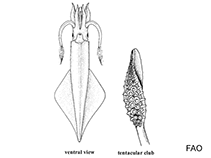
Mantle cylindrical, short, its width about 25% of the mantle length. Fins rhomboidal, length about 60% of mantle length. Tentacular clubs expanded, suckers 56-60, quadriserial, 8 proximal suckers greatly enlarged with smooth rings, teeth absent; medial and distal rings with 7 to 10 very low, broad, plate-like or semilunar teeth. Arm suckers biserial; sucker rings on arm III with 3 to 6 truncate teeth. Left ventral arm hectocotylized along distal 2/3 with about 75 suckerless papillae. (Refs. 275, 128027).
A small-sized, coastal species found ca. 50 m depth (Refs. 275, 128024) (Ref. 275).
Life cycle and mating behavior
Maturity | Reproduction | Spawning | Eggs | Fecundity | Larvae
Members of the class Cephalopoda are gonochoric. Male and female adults usually die shortly after spawning and brooding, respectively. Mating behavior: Males perform various displays to attract potential females for copulation. During copulation, male grasp the female and inserts the hectocotylus into the female's mantle cavity where fertilization usually occurs. Life cycle: Embryos hatch into planktonic stage and live for some time before they grow larger and take up a benthic existence as adults.
Roper, C.F.E., M.J. Sweeney and C.E. Nauen 1984 FAO Species Catalogue. Vol. 3. Cephalopods of the world. An annotated and illustrated catalogue of species of interest to fisheries. FAO Fish. Synop. 125(3):277p. Rome: FAO. (Ref. 275)
IUCN Red List Status
(Ref. 130435: Version 2025-2 (Global))
CITES status (Ref. 108899)
Not Evaluated
Not Evaluated
Threat to humans
Human uses
FAO - Publication: search | FishSource |
Tools
More information
Trophic EcologyFood items (preys)
Diet composition
Food consumption
Predators
Life cycleReproductionMaturityFecunditySpawningEggsEgg developmentLarvae PhysiologyOxygen consumption
Human RelatedStamps, coins, misc.
Internet sources
Estimates based on models
Fishing Vulnerability
(Ref. 71543) |
Low vulnerability (10 of 100). |
Price category
(Ref. 80766): |
Very high. |