Cephalopoda |
Oegopsida |
Cranchiidae | Taoniinae
Environment: milieu / climate zone / depth range / distribution range
Ecology
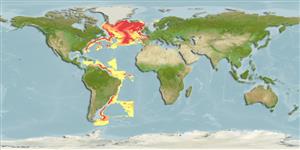
Pelagic; depth range 405 - 4515 m (Ref. 1985). Polar; 66°N -
Atlantic Ocean and the Mediterranean Sea. Subtropical to polar.
Length at first maturity / Size / Weight / Age
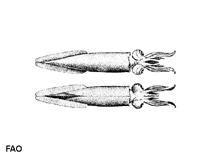
Maturity: Lm ? range ? - ? cm Max length : 40.0 cm ML male/unsexed; (Ref. 122093)
Life cycle and mating behavior
Maturity | Reproduction | Spawning | Eggs | Fecundity | Larvae
Members of the class Cephalopoda are gonochoric. Male and female adults usually die shortly after spawning and brooding, respectively. Mating behavior: Males perform various displays to attract potential females for copulation. During copulation, male grasp the female and inserts the hectocotylus into the female's mantle cavity where fertilization usually occurs. Life cycle: Embryos hatch into planktonic stage and live for some time before they grow larger and take up a benthic existence as adults.
Collins, M.A., C. Yau, L. Allcock and M.H. Thurston 2001 Distribution of deep-water benthic and bentho-pelagic cephalopods from the north-east Atlantic. Journal of the Marine Biological Association of the United Kingdom 81:105-117. (Ref. 1985)
IUCN Red List Status
(Ref. 130435: Version 2025-2 (Global))
CITES status (Ref. 108899)
Not Evaluated
Not Evaluated
Threat to humans
Human uses
FAO - Publication: search | FishSource |
Tools
More information
Trophic EcologyFood items (preys)Diet compositionFood consumptionPredators Population dynamicsGrowth
Max. ages / sizes
Length-weight rel.
Length-length rel.
Length-frequencies
Mass conversion
Abundance
Life cycleReproductionMaturityFecunditySpawningEggsEgg developmentLarvae PhysiologyOxygen consumption
Human RelatedStamps, coins, misc.
Internet sources
Estimates based on models
Fishing Vulnerability
(Ref. 71543) |
Low to moderate vulnerability (30 of 100). |
Price category
(Ref. 80766): |
Medium. |