Bivalvia |
Venerida |
Veneridae
Milieu: milieu / Klimaatzone / Diepte / verspreidingsgebied
Ecologie
Benthic; diepte 0 - 100 m (Ref. 3446). Tropical; 35°N - 28°S, 91°W - 32°W (Ref. 3446)
Western Atlantic: Caribbean to Brazil.
Lengte bij maturiteit / Grootte / Gewicht / Leeftijd
Maturiteit: Lm ? range ? - ? cm Max length : 7.7 cm DL mannelijk / geslacht onbekend; (Ref. 83435); common length : 7.0 cm TL mannelijk / geslacht onbekend; (Ref. 344)
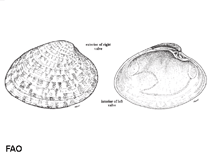
Shell ovate, much less elongate than Macrocallista nimbosa. Surface highly glossy. Sculpture of very fine growth lines under glossy layer. Umbones small. Lunule small. Colour: tan with irregular brown marks, sometimes arranged in radial bands. Internally white.
Lives in coarse sand, often near seagrass beds, in shallow subtidal depths (Ref. 344).
Levenscyclus en paargedrag
Maturiteit | Voortplanting | Paaien | Eieren | Fecunditeit | Larven
Members of the class Bivalvia are mostly gonochoric, some are protandric hermaphrodites. Life cycle: Embryos develop into free-swimming trocophore larvae, succeeded by the bivalve veliger, resembling a miniature clam.
Leal, J.H. 2003 Bivalves. p. 25-98. In Carpenter, K.E. (ed.). The living marine resources of the Western Central Atlantic. Volume 1: Introduction, molluscs, crustaceans, hagfishes, sharks, batoid fishes, and chimaeras. FAO Species Identification Guide for Fishery Purposes and American Society of Ichthyologists and Herpetologists Special Publication No. 5. 1600p. (Ref. 344)
Status op de Rode Lijst van het IUCN
(Ref. 130435: Version 2025-2 (Global))
CITES status (Ref. 108899)
Not Evaluated
Not Evaluated
Gevaar voor de mens
Gebruik door de mens
Visserij: commercieel
FAO - Publication: search | FishSource |
Tools
Meer informatie
Trofische ecologieVoedsel (prooien)
Dieetsamenstelling
Voedselconsumptie
Predatoren
PopulatiedynamicaGroeiMax. leeftijden / matenLengte-gewicht rel.Lengte-lengte rel.LengtefrequentiesMassaconversieAbundantie LevenscyclusVoortplantingMaturiteitFecunditeitPaaienEierenOntwikkeling van de eierenLarven FysiologieZuurstofverbruik
Menselijk gerelateerdPostzegels, munten, diversen.
Internetbronnen
Schattingen op basis van modellen
Weerstandsvermogen
(Ref. 69278): |
Hoog, minimale populatieverdubbelingstijd minder dan 15 maanden (K=0.44) |
Kwetsbaarheid van de visserij
(Ref. 71543) |
Low to moderate vulnerability (27 of 100). |
Prijsklasse
(Ref. 80766): |
Medium. |