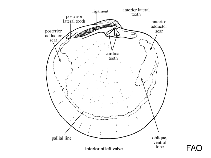
Bivalvia |
Lucinida |
Lucinidae
Milieu: milieu / Klimaatzone / Diepte / verspreidingsgebied
Ecologie
Benthic; brak water; diepte 0 - 2 m (Ref. 87155). Subtropical; 27°C - 28°C (Ref. 87155); 36°N - 29°S, 98°W - 34°W
Western Atlantic: Canada to North Carolina, Florida, Texas, West Indies, Venezuela, Suriname, Brazil (Amapa to Santa Catarina).
Lengte bij maturiteit / Grootte / Gewicht / Leeftijd
Maturiteit: Lm 3.0 range ? - ? cm
Depth range from Belize (Ref. 87155). Minimum depth based on its ecology (Ref.104470). Typically found in calm waters (Ref. 105409). Dominates confined areas of mangrove swamps. Lives deeply burrowed in reducing mud (Ref. 104215). Also in sandy-muddy sediments burrowing from 10 to 20 cm (Ref. 104470). Strictly filter-feeder (Ref. 104242), specifically a suspension feeder (Ref. 105409). In general, suspension feeding bivalves mainly depend on phytoplankton and detritus material for nutrition (Ref. 107088).
Levenscyclus en paargedrag
Maturiteit | Voortplanting | Paaien | Eieren | Fecunditeit | Larven
Life cycle: Embryos develop into free-swimming trocophore larvae, succeeded by the bivalve veliger, resembling a miniature clam (Ref. 833).
Turgeon, D.D., J.F. Quinn Jr., A.E. Bogan, E.V. Coan, F.G. Hochberg, W.G. Lyons, P.M. Mikkelsen, R.J. Neves, C.F.E. Roper, G. Rosenberg, B. Roth, A. Scheltema, F.G. Thompson, M. Vecchione and J.D. Willams 1998 Common and scientific names of aquatic invertebrates from the United States and Canada: Mollusks, 2nd ed. American Fisheries Society (Special publication 26), Bethesda, Maryland. 526 p. (Ref. 1667)
Status op de Rode Lijst van het IUCN
(Ref. 130435: Version 2025-2 (Global))
CITES status (Ref. 108899)
Not Evaluated
Not Evaluated
Gevaar voor de mens
Gebruik door de mens
Visserij: commercieel
FAO - Publication: search | FishSource |
Tools
Meer informatie
PopulatiedynamicaGroeiMax. leeftijden / matenLengte-gewicht rel.Lengte-lengte rel.LengtefrequentiesMassaconversieAbundantie FysiologieZuurstofverbruik
Menselijk gerelateerdPostzegels, munten, diversen.
Internetbronnen
Schattingen op basis van modellen
Kwetsbaarheid van de visserij
(Ref. 71543) |
(0 of 100). |
Prijsklasse
(Ref. 80766): |
Unknown. |