Hexacorallia |
Scleractinia |
Faviidae
Environment: milieu / climate zone / depth range / distribution range
Ecology
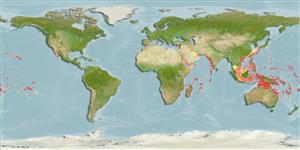
Reef-associated; depth range 0 - 86 m (Ref. 107543). Tropical; 36°N - 34°S, 26°E - 108°W (Ref. 848)
Indo-Pacific: Japan to South Africa and Red Sea to Easter Island. Tropical and subtropical.
Length at first maturity / Size / Weight / Age
Maturity: Lm ? range ? - ? cm
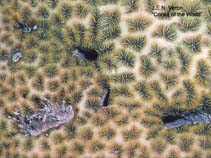
Has a distinctive dark brown coloration with a white oral disc.
Can be found in shallow waters (Ref. 122680). Expands during daytime. Surface is usually pock-marked with barnacles, tube worms, and holes made by Lithophaga sp. (Ref. 130769).
Life cycle and mating behavior
Maturity | Reproduction | Spawning | Eggs | Fecundity | Larvae
Members of the class Anthozoa are either gonochoric or hermaphroditic. Mature gametes are shed into the coelenteron and spawned through the mouth. Life cycle: The zygote develops into a planktonic planula larva. Metamorphosis begins with early morphogenesis of tentacles, septa and pharynx before larval settlement on the aboral end.
Ross, M.A. and G. Hodgson 1981 A quantitative study of hermatypic coral diversity and zonation at Apo Reef, Mindiro, Philippines. Proceedings of the Fourth International Coral Reef Syposium, Manila 2:281-291. (Ref. 8294)
IUCN Red List Status
(Ref. 130435: Version 2025-2 (Global))
CITES status (Ref. 108899)
Not Evaluated
Threat to humans
Human uses
FAO - Publication: search | FishSource |
Tools
More information
Trophic EcologyFood items (preys)
Diet composition
Food consumption
Predators
Population dynamicsGrowthMax. ages / sizesLength-weight rel.Length-length rel.Length-frequenciesMass conversionAbundance Life cycleReproductionMaturityFecunditySpawningEggsEgg developmentLarvae PhysiologyOxygen consumption
Human RelatedStamps, coins, misc.
Internet sources
Estimates based on models
Fishing Vulnerability
(Ref. 71543) |
(0 of 100). |
Price category
(Ref. 80766): |
Unknown. |