Hexacorallia |
Scleractinia |
Merulinidae
Environnement : milieu / zone climatique / profondeur / gamme de distribution
Écologie
Récifal; profondeur 0 - 50 m (Réf. 115197). Tropical; 41°N - 37°S, 26°E - 170°W
Indo-Pacific. Tropical to subtropical.
Longueur à la première maturité / Taille / Poids / Âge
Maturité: Lm ? range ? - ? cmCommon length : 2.0 cm DL mâle / non sexé; (Réf. 269)
Description synthétique
Morphologie
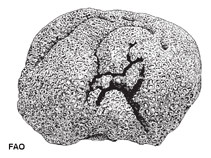
The head coral is one of the numerous species so-called due to their rounded massive shape, similar to a human head. Corallites are evenly distributed, plocoid, exsert, circular or slightly oval, 1 to 2 cm in diameter, and usually separated from each other by a few millimeters. Colonies grow to about 1 m diameter and are found at all depths (Ref. 269). Color varies from grey-green, to brown; often mottled (Ref. 130769).
Corallites are evenly distributed, plocoid, exsert, circular or slightly oval, 1 to 2 cm in diameter, and usually separated from each other by few millimeters. Colonies grow to about 1 m diameter and are found at all depths (Ref. 269). Maximum depth from Ref. 98471. Colonies are found at all depths (Ref. 269). May occur on reef back margins (Ref. 848). Also on subtidal rocks, rocky reefs, outer reef channel, foreslopes, lagoons and inter-reef substrate (Ref. 98471).
Cycle de vie et comportement reproducteur
Maturité | Reproduction | Frai | Œufs | Fécondité | Larves
Hermaphroditic (Refs. 113708, 113712). Mature gametes are shed into the coelenteron and spawned through the mouth. Life cycle: The zygote develops into a planktonic planula larva. Metamorphosis begins with early morphogenesis of tentacles, septa and pharynx before larval settlement on the aboral end (Ref. 833).
Hodgson, G. 1998 Corals. p. 101-122. In Carpenter, K.E. and V.H. Niem (eds) FAO species identifidication guide for fishery purposes. The living marine resources of the Western Central Pacific. Vol. 1. Seaweeds, coral, bivalves and gastropods. FAO Rome. (Réf. 269)
Statut dans la liste rouge de l'IUCN
(Réf. 130435: Version 2025-2 (Global))
statut CITES (Réf. 108899)
Not Evaluated
Menace pour l'homme
Utilisations par l'homme
FAO - Publication: search | FishSource |
Outils
Plus d'informations
Écologie trophiqueAliments (proies)
Composition du régime alimentaire
Consommation alimentaire
Prédateurs
Dynamique des populationsCroissanceÂges / tailles maximalesLongueur-poids rel.Rel. longueur-longueur.Fréquences de longueursConversion de masseAbondance PhysiologieConsommation d'oxygène
Liées à l'hommeTimbres, pièces de monnaie, divers
Sources Internet
Estimations basées sur des modèles
Vulnérabilité de la pêche
(Réf. 71543) |
(0 of 100). |
Catégorie de prix
(Réf. 80766): |
Unknown. |