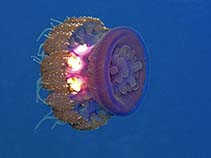
Scyphozoa |
Rhizostomeae |
Cepheidae
Environment: milieu / climate zone / depth range / distribution range
Ecology
Pelagic. Tropical; 46°N - 33°S, 28°E - 138°W
Indo-Pacific: Red Sea to South Africa, north to Russia and east to Marquesas Islands.
Length at first maturity / Size / Weight / Age
Maturity: Lm ? range ? - ? cm Max length : 14.0 cm WD male/unsexed; (Ref. 2992)
10 to 14 cm wide, a large dome at apex, the dome covered completely with about 30 large, pointed warts; 80 to 90 marginal lappets, in each octant 8 to 9 large oval velar lappets between 2 very small, pointed ocular lappets; upper halves of the 8, stout mouth arms nearly coalesced at base, lower halves forked and profusely branched; more than 100 long, tapering, pointed filaments 5 to 6 inter-rhopalar canals in each octant; distinguished by the very deep rhopalar clefts, the long tapering mouth-arm filaments and the brown color.
Edible species which is harvested in Southeast Asia. Bloom was reported in 2011 in seven reefs, and it accumulated in high densities on some beaches of Marsa Alam, Egypt, Red Sea. This is the first record of bloom in the said ecosystem; only second record of such phenomenon since the 1800s (Ref. 116839). Oceanic, occasionally drifting inshore (Ref. 3477). Found stranded along the beach near reef area (Ref. 116581). A bloom--tens of thousands of jellyfish--was recorded for the first time in Marsa Alam, Egypt in the summer of 2011. Assessments of photos estimated densities of up to 20 individuals per cubic meter in some reefs. Tangs and sergeant majors were observed feeding on this species during the bloom (Ref. 116839).
Life cycle and mating behavior
Maturity | Reproduction | Spawning | Eggs | Fecundity | Larvae
Members of the class Scyphozoa are gonochoric. Life cycle: Egg is laid by the adult medusa which later develops into a free-living planula, then to a scyphistoma to a strobila, and lastly to a free-living young medusa.
Kramp, P.L. 1961 Synopsis of the medusae of the world. J Mar Biol Ass UK 40:1-469. (Ref. 2992)
IUCN Red List Status
(Ref. 130435: Version 2025-2 (Global))
CITES status (Ref. 108899)
Not Evaluated
Not Evaluated
Threat to humans
Human uses
Fisheries: commercial
FAO - Publication: search | FishSource |
Tools
More information
Population dynamicsGrowth
Max. ages / sizes
Length-weight rel.
Length-length rel.
Length-frequencies
Mass conversion
Abundance
Life cycleReproductionMaturityFecunditySpawningEggsEgg developmentLarvae PhysiologyOxygen consumption
Human RelatedStamps, coins, misc.
Internet sources
Estimates based on models
Fishing Vulnerability
(Ref. 71543) |
Low vulnerability (10 of 100). |
Price category
(Ref. 80766): |
Unknown. |