Thecostraca |
Balanomorpha |
Balanidae
Environment: milieu / climate zone / depth range / distribution range
Ecology
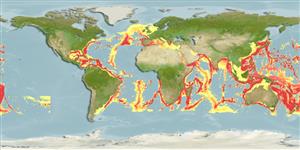
Sessile; depth range 0 - 40 m (Ref. 138196). Tropical; 35°N - 4°S, 47°E - 140°E
Indo-West Pacific: from Kuwait, north to Sagami Bay, Japan and south to Ambon Indonesia. Introduced in the Atlantic and Mediterranean.
Length at first maturity / Size / Weight / Age
Maturity: Lm ? range ? - ? cm Max length : 7.5 cm WD male/unsexed; (Ref. 3719)
Littoral to sublittoral (Ref. 99821). Intertidal (Ref. 106854), in highly exposed shores (Ref. 125338). Known as a fouling species (Ref. 81749).
Life cycle and mating behavior
Maturity | Reproduction | Spawning | Eggs | Fecundity | Larvae
Members of the superorder Thoracica are mostly hermaphroditic. Broadcast spawners, fertilization occurs in the mantle cavity. Life cycle: Eggs hatch into planktonic nauplii and leave the mantle cavity. Afterwards, they undergo six naupliar instars succeded by nonfeeding cypris larva (settling stage) which later metamorphose into adults.
Young, P.S. 1998 Maxillopoda. Thecostraca. p. 263-285. In Young, P.S. (ed.). Catalogue of Crustacea of Brazil. Museo Nacional. Rio de Janeiro. (Ref. 3549)
IUCN Red List Status
(Ref. 130435: Version 2025-2 (Global))
CITES status (Ref. 108899)
Not Evaluated
Not Evaluated
Threat to humans
Human uses
Fisheries: commercial
FAO - Publication: search | FishSource | Sea Around Us
Tools
More information
Trophic EcologyFood items (preys)
Diet composition
Food consumption
Predators
Population dynamicsGrowth
Max. ages / sizes
Length-weight rel.
Length-length rel.
Length-frequencies
Mass conversion
Abundance
Life cycleReproductionMaturityFecunditySpawningEggsEgg developmentLarvae PhysiologyOxygen consumption
Human RelatedStamps, coins, misc.
Internet sources
Estimates based on models
Fishing Vulnerability
(Ref. 71543) |
Low vulnerability (10 of 100). |
Price category
(Ref. 80766): |
Unknown. |