Bivalvia |
Myida |
Myidae
สิ่งแวดล้อม : สิ่งแวดล้อม / เขตภูมิอากาศ / ระดับความลึก / ระยะการกระจายสินค้า
นิเวศวิทยา
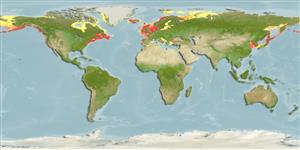
Benthic; กร่อย; ระดับความลึก 0 - 192 m (อ้างอิง 78574), usually 0 - 25 m (อ้างอิง 75831). Temperate, preferred 9°C (อ้างอิง 107945); 48°N - 33°N, 79°W - 56°W
Northwest Atlantic: from St. Pierre Miquelon to North Carolina. Introduced in the North Sea and European waters including the Black, Baltic, Wadden, White and Mediterranean seas, and Eastern Pacific from Alaska to San Francisco.
ความยาวเมื่อครบกำหนดครั้งแรก / ขนาด / น้ำหนัก / อายุ
วัยเจริญพันธุ์: Lm ? range ? - ? cm Max length : 10.0 cm TL เพศผู้/กระเทย; (อ้างอิง 7726); อายุสูงสุดที่ได้รายงาน: 8 ปี (อ้างอิง 2823)
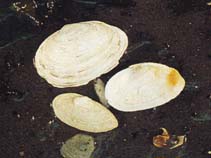
Minimum depth from Ref. 101279. Maximum depth recorded is 329 m (Ref. 101279). Lives in burrows in sand, mud, sandy mud and sandy gravels from the mid shore to the shallow sublittoral, sometimes to a depth of 192 m (Refs. 78574, 137850). Commonly found in estuarine areas, buried in substrate 10 to 20 cm deep (Ref. 95344). In the Vainameri (north-eastern Baltic Sea), abundant in silty substrate (Ref. 95753). Deposit/filter feeders (Ref. 95728). Identified as an ecologically important benthic species of the Baltic Sea, mainly as part of the food base of fishes and its contribution to biofiltration and biosedimentation processes (Ref. 95774). A microvore that feeds on organic detritus (Ref. 96352). Found both in intertidal mudflat and estuary (Refs. 2823, 137850).
วงจรชีวิตและพฤติกรรมการผสมพันธุ์
วัยเจริญพันธุ์ | การสืบพันธุ์ | การวางไข่ | เซลสืบพันธ์ของเพศเมีย(ไข่) | ความดกของไข่ | ตัวอ่อน
Members of the class Bivalvia are mostly gonochoric, some are protandric hermaphrodites. Life cycle: Embryos develop into free-swimming trocophore larvae, succeeded by the bivalve veliger, resembling a miniature clam.
Harvey-Clark, C. 1997 Eastern tidepool and reef: north-central Atlantic marinelife guide. Hancock House Publishers, 64pp. (อ้างอิง 7726)
สถานะบัญชีแดงของ IUCN
(อ้างอิง 130435: Version 2025-2 (Global))
สถานะไซเตส (อ้างอิง 108899)
Not Evaluated
CMS (อ้างอิง 116361)
Not Evaluated
ภัยคุกคามต่อมนุษย์
การใช้ของมนุษย์
การประมง: การค้า
FAO - Aquaculture Systems: production searchการประมง: landings search; Publication: search | FishSource | ทะเลรอบๆเรา
เครื่องมือ
ข้อมูลเพิ่มเติม
วงจรชีวิตการสืบพันธุ์วัยเจริญพันธุ์ความดกของไข่การวางไข่เซลสืบพันธ์ของเพศเมีย(ไข่)การพัฒนาไข่ตัวอ่อน เกี่ยวข้องกับมนุษย์แสตมป์ เหรียญ อื่นๆ
แหล่งที่มาจากอินเตอร์เน็ต
การประมาณค่าตามแบบจำลอง
ความสามารถในการกลับคืนสู่ปกติ
(Ref. 69278): |
ขนาดกลาง, เวลาต่ำสุดที่จะทำให้ประชากรเพิ่มขึ้นเป็น 2 เท่าใช้เวลา 1.4 - 4.4 ปี (K=0.14-0.48; tmax=8) |
ความเสี่ยงต่อการตกปลา
(อ้างอิง 71543) |
Moderate vulnerability (36 of 100). |
ความเสี่ยงต่อสภาพภูมิอากาศ
(อ้างอิง 125649) |
Moderate to high vulnerability (51 of 100) |
หมวดหมู่ราคา
(อ้างอิง 80766): |
High. |
Nutrients
|
Calcium = 149 [71, 228] mg/100g; Iron = 8.53 [1.95, 15.11] mg/100g; Protein = 9.88 [8.64, 11.12] %; Omega3 = 0.313 [0.202, 0.423] g/100g; Selenium = 61 [50, 72] μg/100g; VitaminA = 0 μg/100g; Zinc = 2.04 [0.56, 3.51] mg/100g (wet weight); based on nutrient studies. |