Malacostraca |
Decapoda |
Pandalidae
Umwelt: Milieu / Klimazone / Tiefenbereich / Verbreitungsgebiet
Ökologie
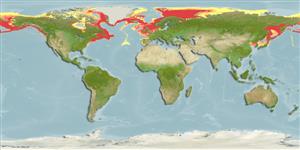
Benthopelagisch; tiefenbereich 9 - 1450 m (Ref. 85480), usually 50 - 500 m (Ref. 85480). Boreal; -2°C - 12°C (Ref. 85480), preferred 4°C (Ref. 107945); 82°N - 32°N, 180°W - 180°E
Circumboreal: from Vrangelye Island, Chukchi Sea, north to Greenland and Franz Josef Land, Barents Sea, east to Russia, East Siberian Sea. Polar to temperate.
Länge bei der ersten Reifung / Größe / Gewicht / Alter
Geschlechtsreife: Lm 2.4, range 2 - 2.443 cm Max length : 12.0 cm TL Männchen/unbestimmt; (Ref. 8); 16.5 cm TL (female)
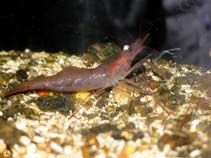
Commonly known as the "pink" shrimp, it is slender and has a smooth body surface. The shell is somewhat thin, making it more difficult to transport in good condition than the other species. Moreover, although a deep red when alive, it becornes pink after boiling, a quality which also detracts from the commercial value of the unshelled product. The rostrum is about one and three fourths times as long as the carapace, slightly arched above the eyes, terminal half slightly ascending, armed with 12 to 16 teeth above (including 3 or 4 on the carapace), 6 to g teeth below, tip bifid. The anterior dorsal spine is situated at least as far forward as the distal third of the rostrum.
Considered as free-living (Ref. 3123) stenohaline species living on soft substrates with high organic content. It is an opportunistic omnivore functioning as a predator and a scavenger (Ref. 85480).
Post-larvae mature first as males for 2 years, sex transition begins afterwards. Spawning begins on the third winter, hatching occurs during spring (Ref. 82652). Reproductive mode from Ref. 91801.
Piepenburg, D., N.V. Chernova, C.F. von Dorrien, J. Gutt, A.V. Neyelov, E. Rachor, L. Saldanha and M.K. Schmid 1996 Megabenthic communities in the waters around Svalbard. Polar Biol. 16:431-446. (Ref. 2952)
IUCN Rote Liste Status
(Ref. 130435: Version 2025-2 (Global))
CITES Status (Ref. 108899)
Not Evaluated
Not Evaluated
Bedrohung für Menschen
Nutzung durch Menschen
Fischereien: kommerziell
FAO - Fischereien: Artbeschreibung, landings search; Publication: search | FIRMS (Stock assessments) | FishSource | Das Meer um uns herum
Tools
Mehr Information
MenschenbezogenBriefmarken, Münzen, Verschiedenes.
Internet Quellen
Schätzungen auf der Grundlage von Modellen
Widerstandsfähigkeit
(Ref. 69278): |
mittel, Verdopplung der Population dauert 1,4 - 4,4 Jahre. (K=0.16-0.29; tm=5.71) |
Rate of population increase
|
Prior r = 0.62, 95% CL = 0.41 - 0.93, Based on 7 full stock assessments. |
Anfälligkeit der Fischerei
(Ref. 71543) |
Moderate vulnerability (40 of 100). |
Klimaanfälligkeit
(Ref. 125649) |
Low vulnerability (25 of 100) |
Preiskategorie
(Ref. 80766): |
Very high. |
Nutrients
|
Calcium = 109 [35, 184] mg/100g; Iron = 1.59 [1.21, 1.97] mg/100g; Protein = 20.2 [19.2, 21.3] %; Omega3 = 0.285 [0.185, 0.386] g/100g; Selenium = 48.3 [-31.7, 128.3] μg/100g; VitaminA = 0 μg/100g; Zinc = 1.79 [1.17, 2.40] mg/100g (wet weight); based on nutrient studies. |