Echinoidea |
Diadematoida |
Diadematidae
Ambiente: milieu / zona climatica / distribuzione batimetrica / gamma di distribuzione
Ecologia
Associati a barriera corallina; distribuzione batimetrica 0 - 70 m (Fonte Biblio. 81020). Tropical
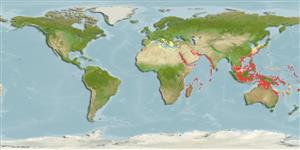
Indo-Pacific: from Red Sea to South Pacific Islands and Japan. Introduced in the Mediterranean.
Lunghezza alla prima maturità / Dimensione / Peso / Età
Maturità: Lm ? range ? - ? cm
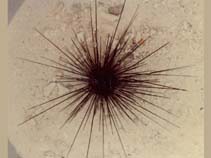
Body is covered with long spines, with many shorter spines in between. Spines are black or dark purple, with the long ones often black-and-white banded, or white in color. Five bright white or blue spots are present on the test. The anal cone has a distinctive bright orange ring.
Common in the sublittoral fringe around protected rocky coastlines (Ref. 102838). Found on muddy substrate (Ref. 2931). Occurs in assemblages in reef areas with high percentage of dead corals (Ref. 800). Common on Porites-dominated coral reefs; less common on Acropora assemblage (Ref. 102838). Feeds on algae (Also Ref. 128613) that grows on dead corals or rubble area (Ref. 800). Dwells in rocky and sandy substrates at depths of 1-70m. Also inhabits coral reefs and sea grass meadows. Hides in rocky crevices particularly when under intense light. Recorded from subsurface water temperatures of 16.9-30.8°C, oxygen concentration of 7.5 mg/L, and salinities of 36.4-38.7 per mille (Ref. 128613). Associated with coral communities. Dwells on soft substrates. Grazes on encrusting algae over hard substrates at night. Bioeroder. Keeps algal growth in check (Ref. 129602).
Ciclo vitale e comportamento di accoppiamento
Maturità | Riproduzione | Deposizione | Uova | Fecondità | Larve
Members of the class Echinoidea are gonochoric. Fertilization is external. Brooding is common, eggs are held either on the peristome, around the periproct or deep into the concavities on the petaloids. Life cycle: Embryos develop into planktotrophic larvae (echinoplateus) and live for several months before they sink to the bottom using their tube feet to adhere on the ground where they metamorphose into young urchins.
Schoppe, S. 2000 A guide to common shallow water sea stars, brittle stars, sea urchins, sea cucumbers and feather stars (echinoderms) of the Philippines. Times Media Private Limited, Singapore. 144 p. (Fonte Biblio. 800)
Stato della Lista Rossa IUCN
(Fonte Biblio. 130435: Version 2025-2 (Global))
Stato della CITES (Fonte Biblio. 108899)
Not Evaluated
CMS (Fonte Biblio. 116361)
Not Evaluated
Minaccia per l'uomo
Venomous (Fonte Biblio. 129602)
Usi umani
FAO - Publication: search | FishSource |
Strumenti
Informazioni ulteriori
Dinamica della popolazioneAccrescimentoEtà massima / dimensioni massimeRapporto lunghezza-peso.Lunghezza-lunghezza rel.Lunghezza-frequenzeConversione di massaAbbondanza FisiologiaConsumo di ossigeno
Legato all'uomoFrancobolli, monete, materiale vario.
Fonti Internet
Stime basate su modelli
Vulnerabilità della pesca
(Fonte Biblio. 71543) |
(0 of 100). |
Categoria di prezzo
(Fonte Biblio. 80766): |
Unknown. |