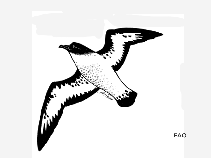
Aves |
Procellariiformes |
Procellariidae
Environment: milieu / climate zone / depth range / distribution range
Ecology
Others. Polar
Indo-Pacific, Atlantic Ocean, Mediterranean and Antarctic. Subtropical to polar.
Length at first maturity / Size / Weight / Age
Maturity: Lm ? range ? - ? cm Max length : 40.0 cm TL male/unsexed; (Ref. 8812); max. published weight: 441.00 g (Ref. 356)
Culmen: 1.58 cm; tarsus: 1.83 cm; wing: 26.0 cm.
Total Length: 38 to 40 cm; Wingspan: 81 to 91 cm (Ref. 8812). Circumpolar (Ref. 91362). Found over open-water (Ref. 356). Follows ships. A gregarious species; noisy and quarrelsome when feeding on ship galley waste (Ref. 91362). Exhibits surface-seizing, foot paddling and pattering (Ref. 356). Breeds colonially (Ref. 91362).
Life cycle and mating behavior
Maturity | Reproduction | Spawning | Eggs | Fecundity | Larvae
Brooke, M. de L. 1995 The modern avifauna of the Pitcairn Islands. Biological Journal of the Linnean Society 56:199-212. (Ref. 5718)
IUCN Red List Status
(Ref. 130435: Version 2025-2 (Global))
CITES status (Ref. 108899)
Not Evaluated
Not Evaluated
Threat to humans
Human uses
FAO - Publication: search | FishSource |
Tools
More information
Population dynamicsGrowthMax. ages / sizesLength-weight rel.Length-length rel.Length-frequenciesMass conversionAbundance Life cycleReproductionMaturityFecunditySpawningEggsEgg developmentLarvae PhysiologyOxygen consumption
Human RelatedStamps, coins, misc.
Internet sources
Estimates based on models
Resilience
(Ref. 69278): |
High, minimum population doubling time less than 15 months (K=8.86-41.08) |
Fishing Vulnerability
(Ref. 71543) |
Low to moderate vulnerability (30 of 100). |
Price category
(Ref. 80766): |
Unknown. |