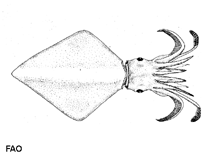
Cephalopoda |
Oegopsida |
Thysanoteuthidae
Umwelt: Milieu / Klimazone / Tiefenbereich / Verbreitungsgebiet
Ökologie
Pelagisch; tiefenbereich 0 - 2604 m (Ref. 83938). Tropical; 20°C - 26°C (Ref. 95878); 51°N - 42°S, 180°W - 180°E (Ref. 107076)
Circumglobal in tropical and subtropical waters.
Länge bei der ersten Reifung / Größe / Gewicht / Alter
Geschlechtsreife: Lm 60.0, range 55 - 65 cm Max length : 130 cm ML Männchen/unbestimmt; (Ref. 104052); common length : 60.0 cm ML Männchen/unbestimmt; (Ref. 417); max. veröff. Gewicht: 30.0 kg (Ref. 97142)
Caught with set nets and drifting jigs (Ref. 417). Maximum mantle length of both sexes is the same, 100 cm, possibly to 130 cm (Ref. 97142). Maximum depth from Ref. 104455. An oceanic species (Ref. 83938), only rarely approaches the shelf zone (Ref. 122970). Occupies epipelagic to upper mesopelagic depths, and undergoes diel vertical migrations. Cosmopolitan, common circumglobal inhabitant of warm tropical and subtropical open waters, only rarely approaching the shelf zone (Ref. 97142). Occurs in a front (Ref. 122966). Avoids the oligotrophic central waters of the open ocean. Also reaches higher latitudes into temperate boreal and notalian regions, transported by warm currents, e.g. the Tsushima, Kuroshio, Agulhas, Brazil Currents and the Gulf Stream. Not an active swimmer during most of its life cycle, rather, it propels itself slowly by gentle undulation of its long, broad, diamond-shaped fins. However, is capable of a powerful reactive jet of short duration when threatened. Such low-energy life style promotes very high growth rates, among the highest of all squids. By the age of 300 days, may reach 800 mm mantle length and 17.5 kg body weight. Males reach maturity mainly at 400 to 550 mm mantle length (age 170 to 200 days), and females mature at 550 to 650 mm mantle length (age 230 to 250 days). Life span is 1 year. Spawning lasts throughout the year in tropical waters and during the warm season in peripheral regions. Spawning is intermittent, with multiple fillings and evacuations of the oviducts. Mating occurs in the "head to head" position. The social organization is unique among squids: consists of pairs formed of same-sized males and females that occur at an immature stage of less than 100 mm mantle length, and probably remain together constantly during their lifetimes (monogamy). Small schools of pairs may be locally common. Arm length and probably the anal photophore play the key role in pair formation in immature squids. Juveniles feed on crustaceans, small cephalopods and fishes in subsurface waters, but subadults and adults feed mainly in daytime in deep-water layers mostly from 400 to 650 m on dense concentrations of non-active midwater fishes. Predators include different species of ommastrephid squids, dolphin fish, lancet fish, various species of tuna, swordfish, Gempylus serpens, sharks and mammals (e.g. dolphins, rough-toothed dolphin, false killer whale, sperm whale). Valued for its firm and flavorful flesh, its high commercial value makes it an important target species along the coastal waters of the Sea of Japan and around Okinawa (Ref. 97142).
Lebenszyklus und Paarungsverhalten
Geschlechtsreife | Fortpflanzung | Ablaichen | Eier | Fruchtbarkeit | Larven
During copulation, female and male mate in a head-to-head position. The male transfers its spermatophores to the female via the hectocotylus, which attaches to the surface of the female's buccal membrane. Spawning occurs throughout the year, in tropical waters during summer and early autumn, and lasts for 2-3 months. During spawning, females first produce a secretion of the nidamental glands like that of the ommastrephid Todarodespacificus. The secretion enters the water, and swells, and the female molds it into a cylinder. After that, the oviductal glands start to work, forming 2 mucous threads, each with 1 row of eggs. In the mantle cavity both threads fuse and develop into a single cord containing a double row of eggs. This cord exits into the water through the funnel, and the eggs are fertilized with spermatozoa from seminal receptacles located in the female's buccal membrane. The female then winds the cord of eggs onto the cylinder. As a result, the structure of the egg mass is uniform, as observed in natural egg masses of T. rhombus (Ref. 95878).
Schneider, W. 1990 FAO species identification sheets for fishery purposes. Field guide to the commercial marine resources of the Gulf of Guinea. Prepared and published with the support of the FAO Regional Office for Africa. Rome: FAO. 268 p. (Ref. 417)
IUCN Rote Liste Status
(Ref. 130435: Version 2025-2 (Global))
CITES Status (Ref. 108899)
Not Evaluated
Not Evaluated
Bedrohung für Menschen
Nutzung durch Menschen
Fischereien: kommerziell
FAO - Publication: search | FishSource |
Tools
Mehr Information
PhysiologieSauerstoffverbrauch
MenschenbezogenBriefmarken, Münzen, Verschiedenes.
Internet Quellen
Schätzungen auf der Grundlage von Modellen
Widerstandsfähigkeit
(Ref. 69278): |
hoch, Verdopplung der Population dauert weniger als 15 Monate. (K=0.84; tm=0.68) |
Anfälligkeit der Fischerei
(Ref. 71543) |
Moderate vulnerability (38 of 100). |
Preiskategorie
(Ref. 80766): |
Medium. |