Polychaeta |
Terebellida |
Terebellidae
Milieu: milieu / Klimaatzone / Diepte / verspreidingsgebied
Ecologie
Sessile; brak water; diepte 6 - 81 m (Ref. 112705). Temperate
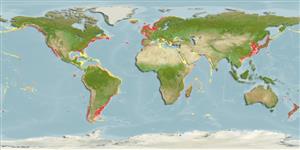
Atlantic Ocean, the Mediterranean and Indo-Pacific.
Lengte bij maturiteit / Grootte / Gewicht / Leeftijd
Maturiteit: Lm ? range ? - ? cm Max length : 30.0 cm TL mannelijk / geslacht onbekend; (Ref. 7882)
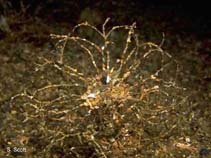
Species' maximum length from the Belgian part of the North Sea (Ref. 7882). Minimum depth from Ref. 127093. Found in estuarine and inshore areas associated with organic pollutants (Ref. 96352). A tube-living bristle worm found along the near-coastal zone in a variety of sediments often in areas of fine to medium-grained sediment with a high mud content. The tube has a fan-shaped top and a grouping of several tubes form "sand reefs" (Ref. 7882). A surface deposit-feeder (Ref. 96292) and an interface-feeder (Ref. 96376). Feeds on organic detritus (Ref. 96352).
Levenscyclus en paargedrag
Maturiteit | Voortplanting | Paaien | Eieren | Fecunditeit | Larven
Members of the class Polychaeta are mostly gonochoric (sexual). Mating: Females produce a pheromone attracting and signalling the males to shed sperm which in turn stimulates females to shed eggs, this behavior is known as swarming. Gametes are spawned through the metanephridia or body wall rupturing (termed as "epitoky", wherein a pelagic, reproductive individual, "epitoke", is formed from a benthic, nonreproductive individual, "atoke"). After fertilization, most eggs become planktonic; although some are retained in the worm tubes or burrowed in jelly masses attached to the tubes (egg brooders). Life Cycle: Eggs develop into trocophore larva, which later metamorph into juvenile stage (body lengthened), and later develop into adults.
Harms, J. 1993 Check list of species (algae, invertebrates and vertebrates) found in the vicinity of the island of Helgoland (North Sea, German Bight) - a review of recent records. Helgoländer Meeresunters 47:1-34. (Ref. 2711)
Status op de Rode Lijst van het IUCN
(Ref. 130435: Version 2025-2 (Global))
CITES status (Ref. 108899)
Not Evaluated
Not Evaluated
Gevaar voor de mens
Gebruik door de mens
FAO - Publication: search | FishSource |
Tools
Meer informatie
LevenscyclusVoortplantingMaturiteitFecunditeitPaaienEierenOntwikkeling van de eierenLarven FysiologieZuurstofverbruik
Menselijk gerelateerdPostzegels, munten, diversen.
Internetbronnen
Schattingen op basis van modellen
Kwetsbaarheid van de visserij
(Ref. 71543) |
Low vulnerability (20 of 100). |
Prijsklasse
(Ref. 80766): |
Unknown. |