Phaeophyceae |
Fucales |
Sargassaceae
पर्यावरण: पर्यावरण / जलवायु क्षेत्र / गहराई सीमा / वितरण सीमा
पारिस्थितिकी
Sessile. Tropical
Indo-Pacific Ocean.
प्रथम परिपक्वता पर लंबाई / आकार / वज़न / आयु
परिपक्व अवधि: Lm ? range ? - ? cm
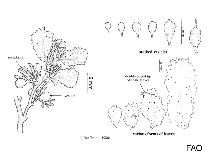
Large, dark brown thalli attached to substrate by a discoid holdfast; a short (less than 1 cm) and slender stem, giving rise to 1 or 2 main somewhat compressed and smooth primary branches. Branchlets bearing leaves and vesicles alternately arranged on the primary branches; leaves generally oblong (2.5 to 3.5 cm long) and obovate (2.0 to 3.0 cm long), with coarsely toothed outer margins, cryptostomata scattered on both surfaces; distal portions of some leaves with thick duplicate margins. Vesicles sparse, pedunculate, attached to the stalk of the leaves, elliptical to spherical, 4 to 11 mm in diameter, with isolated lateral teeth or ridges, sometimes with foliaceous extensions. Receptacles forming simple to compound cymes with short stalks; receptacular branches once or twice branched, compressed to flattened at their distal portions with teeth at tips and margins. Thalli up to 50 cm in height (Ref. 80758).
A good biomass source for biogas production; used as fertilizer, as human food, animal fodder and medicine; also a very good source of alginate which is used in the food industry; possesses growth regulator substances similar to auxin, gibberellin, and cytokinin (Ref. 80758). Shows an intra-annual pattern of variation in standing crop similar to S. crassifolium. Its standing crop is lowest in the period from February to May and highest from November to January (Ref. 80758). Found on coralline rocks in wave-exposed low intertidal to shallow subtidal areas (Ref. 80758).
जीवन चक्र और संभोग व्यवहार
परिपक्व अवधि | पुनरुत्पत्ति | मछलीऔ का अंडे देना | अंडे | उपजाऊपन | लार्वा
Guiry, M.D. and G.M. Guiry 2009 AlgaeBase. World-wide electronic publication, National University of Ireland, Galway. http://www.algaebase.org; searched on 14 April 2009. (संदर्भ 80701)
आईयूसीएन रेड लिस्ट स्थिति
(संदर्भ 130435: Version 2025-2 (Global))
CITES स्थिति (संदर्भ 108899)
Not Evaluated
CMS (संदर्भ 116361)
Not Evaluated
मनुष्यों के लिए ख़तरा
मानव उपयोग
FAO - Publication: search | FishSource |
साधन
अधिक जानकारी
ट्रॉफिक पारिस्थितिकीखाद्य पदार्थ (शिकार)संघटक आहारआहार खपतपरभक्षी जनसंख्या गतिशीलताबाढ़
अधिकतम आयु/आकार
लंबाई-वजन संबंध
लंबाई-लंबाई संबंध
लंबाई-आवृत्तियाँ
सामूहिक रूपांतरण
बहुतायत
जीवन चक्रपुनरुत्पत्तिपरिपक्व अवधिउपजाऊपनमछलीऔ का अंडे देनाअंडेअंडे का विकासलार्वा फिजियोलॉजीप्राणवायु की खपत
मानव संबंधीटिकट, सिक्के, विविध.
इंटरनेट स्रोत
मॉडल पर आधारित अनुमान
मछली पकड़ने की भेद्यता
(संदर्भ 71543) |
(0 of 100). |