Ulvophyceae |
Ulvales |
Ulvaceae
Environnement : milieu / zone climatique / profondeur / gamme de distribution
Écologie
Sessile; profondeur 0 - 20 m (Réf. 101733). Subtropical
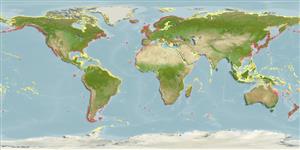
Arctic, Indo-Pacific, Atlantic Ocean, Mediterranean and Black Sea. Subtropical to polar.
Longueur à la première maturité / Taille / Poids / Âge
Maturité: Lm ? range ? - ? cm Max length : 20.0 cm H mâle / non sexé; (Réf. 80758)
Description synthétique
Morphologie
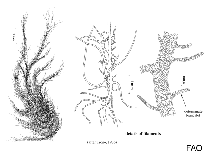
Thalli bright to yellowish green. Several unbranched tubular branches arise from a short stipe; discoid holdfast. Erect branches tapering below, inflated above and constricted or contorted at certain points. Cells polyhedral in surface view, irregularly arranged and filled with spherical to oval chloroplasts.
Grows on rocky substrate in the lower intertidal to shallow subtidal zones or in shallow tidepools exposed to air during low tide (Ref. 80758); also considered as a fresh sea-vegetable (Ref. 82232). Inhabits rocky substrate in the lower intertidal to shallow subtidal zones or in shallow tidepools exposed to air during low tide (Ref. 80758). Also found in supra-littoral pools that are influenced by wave splashes (Ref. 83307) as well as sandy areas where rock attachment is possible (Ref. 801).
Cycle de vie et comportement reproducteur
Maturité | Reproduction | Frai | Œufs | Fécondité | Larves
Guiry, M.D. and G.M. Guiry 2009 AlgaeBase. World-wide electronic publication, National University of Ireland, Galway. http://www.algaebase.org; searched on 14 April 2009. (Réf. 80701)
Statut dans la liste rouge de l'IUCN
(Réf. 130435: Version 2025-2 (Global))
statut CITES (Réf. 108899)
Not Evaluated
Not Evaluated
Menace pour l'homme
Utilisations par l'homme
Pêcheries: commercial; Aquaculture: commercial
FAO - Publication: search | FishSource |
Outils
Plus d'informations
Écologie trophiqueAliments (proies)
Composition du régime alimentaire
Consommation alimentaire
Prédateurs
Dynamique des populationsCroissanceÂges / tailles maximalesLongueur-poids rel.Rel. longueur-longueur.Fréquences de longueursConversion de masseAbondance Cycle de vieReproductionMaturitéFéconditéFraiŒufsDéveloppement de l'œufLarves PhysiologieConsommation d'oxygène
Liées à l'hommeTimbres, pièces de monnaie, divers
Sources Internet
Estimations basées sur des modèles
Vulnérabilité de la pêche
(Réf. 71543) |
Low vulnerability (10 of 100). |